
Dr. Zac Cartun, a newly minted graduate of UMass Chan Medical School, had just arrived at the Paris business school INSEAD in 2023 when he saw a note asking if anyone wanted to collaborate on a custom orthotics business together.
During medical school, Cartun felt that he had “blinders on,” that he just needed to put his head down and get through it. In Paris, he wanted to try out different opportunities, as many as he could find.
“I just said yes,” said Cartun, now 31 and a Brookline resident.
The note was from Greg Gerla, a fellow American who was doing a business school exchange program with Northwestern. Gerla was upset because he had paid hundreds of dollars for custom orthotics that reached his house after he left for Paris.
The idea was to create an easy, mess-free process for receiving custom insoles. Instead of going into the podiatrist’s office or creating an imprint of your foot in foam, customers would provide information about their issues and photos of their feet, and orthotics would arrive at their door a few weeks later.
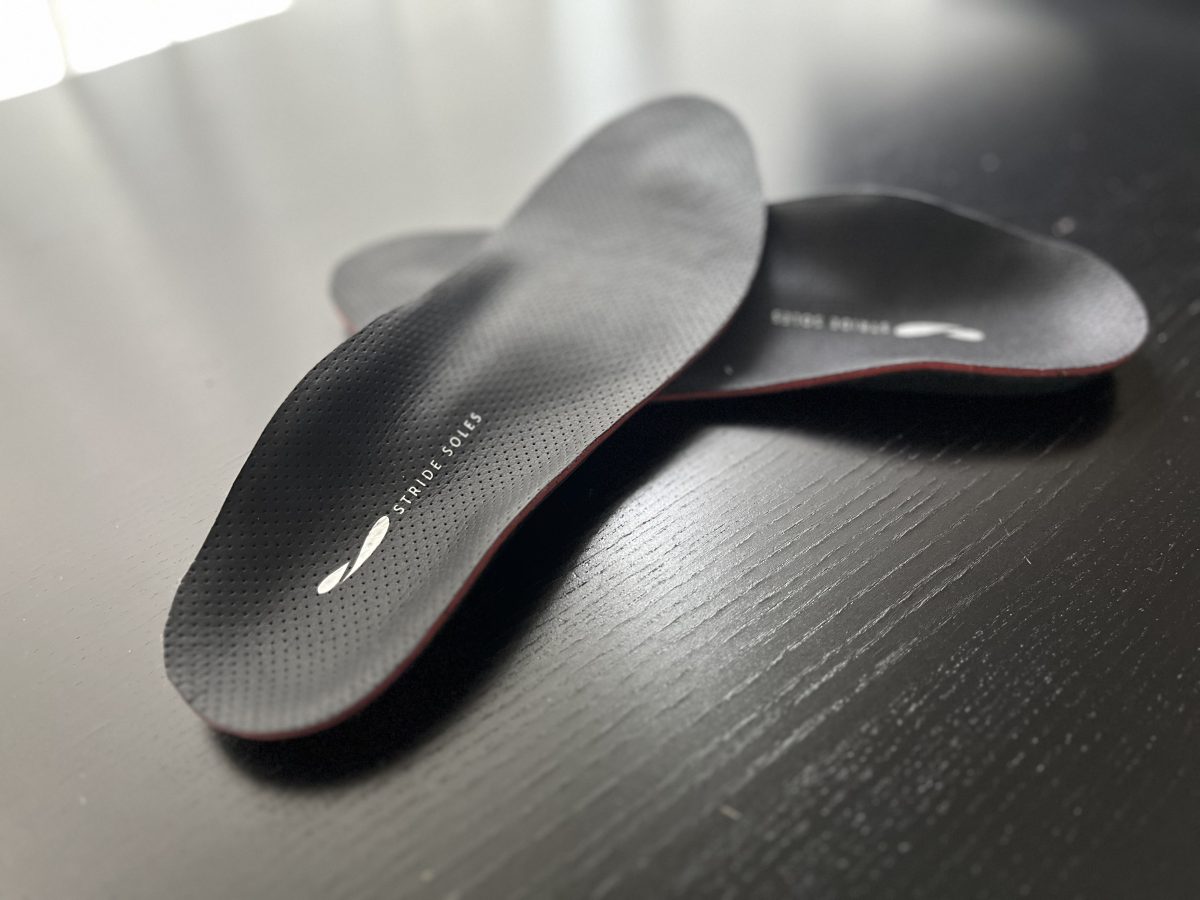
That idea has now become a company called Stride Soles, which has sold 560 pairs of its custom orthotics. Cartun is its co-founder and chief medical officer.
Having studied radiology in medical school, Cartun didn’t know much about podiatry, but he was familiar with the business of at-home medical care that relies on technology. Before business school, Cartun worked at Pulsenmore, a company that facilitates and interprets at-home ultrasounds. It’s like doing a “Facetime call with your OBGYN,” Cartun said.
The ultrasound app required real time feedback to get an accurate scan. Users needed to know when they were applying too much pressure and when they needed more gel. The technology excited Cartun.
“I remember being really impressed by the power of the phone as a medical device,” he said.
After they teamed up, Cartun and Gerla spent the next few months reaching out to podiatrists and orthotics manufacturers in the United States and Europe.
They learned that there is an ideal alignment of the foot — called subtalar neutral — in podiatry scans. They learned that doctors were split on whether the scan needed to be weight-bearing, non-weight-bearing, or partial weight-bearing. They also met a German podiatry clinic and orthotics manufacturer who would end up being their partner as they grew Stride Soles.
Then, they started on the scanning app. Cartun had a vision based on his experience at Pulsenmore, but he needed feet – a lot of them – to build it.
Cartun learned that a friend from medical school was working on a research study and had a database featuring photos of feet. They maneuvered the photos to be in the right positions and created the model for their app.
“Figuring out who we were”
Now that they had a business idea and funding through INSEAD — the project was awarded €35,000 from the school and €10,000 from an additional venture capital firm — Cartun and his team worked on getting insoles out the door, which took some trial and error.
“It’s been a year figuring out who we were,” Cartun said in December.
First, Cartun and Gerla went to physical therapists and chiropractors, asking them to tell their clients with foot pain about it. They had 15 providers using their “solution,” as they call it, but Stride Soles wasn’t taking off.
Beginning in September of this year, the company started offering direct-to-consumer service on their website.
“There’s something romantic about this grassroots thing, and it seems to be working slowly so far,” Cartun said.
Stride Soles joins other medtech startups in Brookline, like Walkky, an AI-driven platform that detects and manages cardiovascular disease with an ECG, that are updating traditional practices for the technological present.
“Really exciting technology [is] happening in Brookline,” said Hagar Spits, a Boston-area startup consultant and Cartun’s former boss at Pulsenmore.
To her, Stride Soles is an answer to an “unmet need” within a “broken process” that doesn’t work today.
How Stride Soles works
The company is still trying to match customer demand with its capacity, which has been a learning curve. During Cyber Monday, it released a special offer and got 40 orders in one day, which stretched the teams’ limits, but they got the orders out.
Their process begins when someone takes an online survey. The questions are all informed by podiatrists and reflect what they would ask during an appointment: “Which type of arch best represents your feet?” and “How often do your feet hurt?”
Then, they request a 3D scan of the individual’s foot. “Think Apple Face ID,” the website says. The scanning app relies on “patient-driven imaging.”
In traditional medicine, patients would need to go to the hospital and meet with a certain person who was designated to do the task.
“With technology, there’s just so many ways to make it more efficient,” Cartun said.
Next, they ask for a video of the person walking.
All this information goes to the German podiatry clinic, which designs the insole. The design file comes back, and Stride Soles 3D-prints the pair of orthotics.
Then they are shipped out the door and end up in the patients’ shoes.
For Cartun, who also works as a consultant for pharmaceutical studies, Stride Soles represents a divergence from the more traditional career path he was expecting. When he arrived at INSEAD, Cartun couldn’t help but wonder if he should have continued on as a doctor.
“Every day I was just like, ‘should I just be doing residency?’” he said.
Now, Cartun’s enjoying his work trying to help relieve foot pain, even though it’s an unexpected turn.
“I can’t believe I talk about orthotics so much in my life,” he said.