

A brewing development conflict on Bellingham Road has all the tension points that have become common in Brookline: Neighbors pushing back against a proposed new project, legal challenges and town boards and commissions deliberating as the town weighs its options.
But there’s a new wrinkle to this familiar back-and-forth: It’s not a fight over condos or an apartment building, but about plans for a new Jewish synagogue in the South Brookline neighborhood.
The Chabad Center at Chestnut Hill, a 20-year-old synagogue currently located at 163 Bellingham Road, is making plans for a new 30,000 square foot building on properties that it owns down the street at 90 and 100 Bellingham Road.
When Rabbi Mendy Uminer started the congregation with his wife in the early 2000s, it consisted of about seven families. These days, the synagogue holds Sabbath services on Saturday for 75 to 100 people, and hosts smaller services on weekday mornings. It also runs a religious school on Sundays.
“We’ve been quite successful on many fronts and have tried for years to find the right place, a permanent home,” said Uminer. “We’re a proud Jewish community, young and thriving. I would say it’s a place where every Jew could call home.”
The current building is too small to meet the community’s needs, so the congregation purchased the two new properties for $1.2 million and $1.4 million respectively last year.
Its plans for a new building include a synagogue to seat 200 worshippers, along with a social hall to host holiday, wedding and bar and bat mitzvah celebrations, space for administrative offices, and classrooms for religious school and preschool.

Neighbors try to fight building project
However, some members of the community, neighbors on Bellingham Road and other nearby streets, have sought to slow or block the project, worried about the impact on their neighborhood.
The size of the buliding, as well as the changes it will bring to traffic and parking, is going to “change the neighborhood forever,” said Bellingham Road resident Sara Rouhanifard. “It really belongs in a non-residential space. We feel like our hands are tied, and everyone’s really devastated.”
Sarah Shao, another neighbor, said the organization has been “disregarding the neighborhood,” which she says is filled with mostly modest homes.
“We’re not opposing them building something, but the size of this, the magnitude of it, is not really aligned with the neighborhood,” she said.
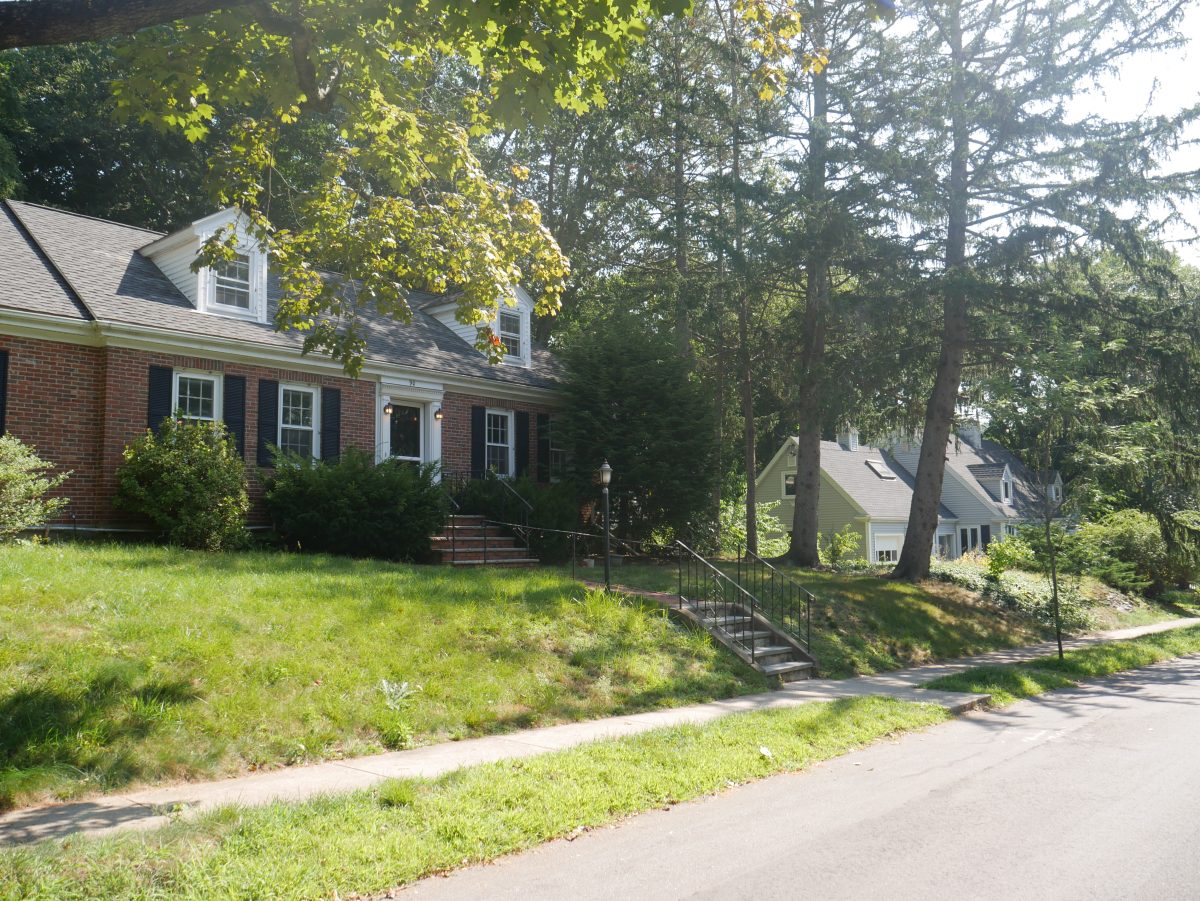
They and other neighbors, including around 40 people who have signed a petition, made the case to the town that the existing homes at 90 and 100 Bellingham Road should not be allowed to be demolished, because they are worthy of historic preservation – a common tactic used in Brookline to try to slow or stop various types of development.
Legal jockeying commences
The neighbors won an early victory at a meeting on Aug. 13 when the town’s Preservation Commission found the two buildings to be historically significant.
What that generally means is that the property owner must hold off on demolishing the buildings for 12 months.
However, in this case, the property owner’s plans for a religious use may bring into play special legal protections.
Jeffrey Allen, an attorney for the Chabad Center, said that he is asking the commission to lift the demolition delay in deference to a federal law called the Religious Land Use and Institutionalized Persons Act.
Broadly speaking, it protects individuals, houses of worship, and other religious institutions from discrimination in zoning.
“That statute would preclude the town from stopping my client from demolishing these properties,” Allen said.
Neighbors of the project will have “plenty of time” to talk about the design, density issues, and more in future town hearings, Allen said. But in the meantime, he’s arguing that the demolitions should be allowed to go forward.
What’s next?
The Preservation Commission is planning to hold another hearing on the issue on Sept. 10, when town attorneys are expected to lay out their interpretation of the relevant federal law. and then let the commission decide how to move forward.