
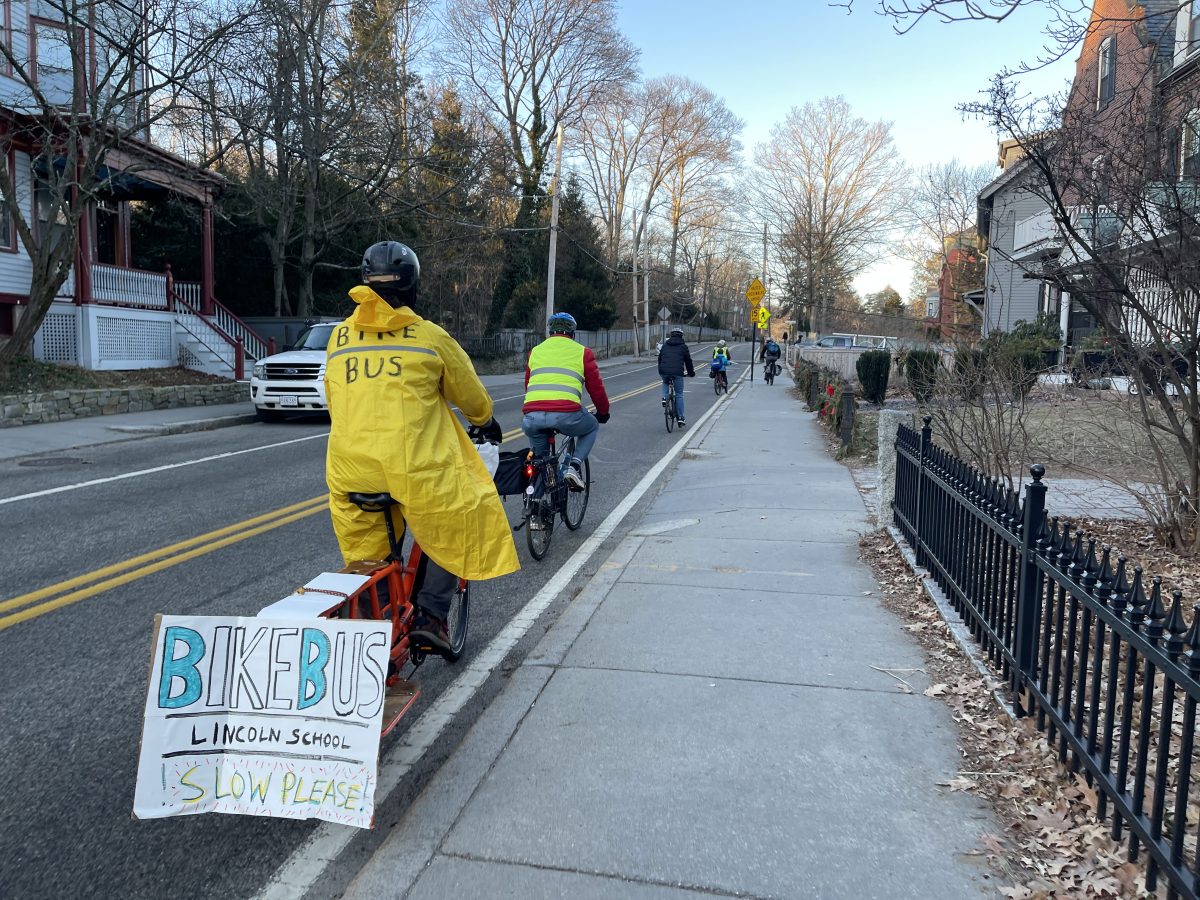
On a Wednesday morning in February, Yugo Shimada, a third-grade student at the Lincoln School, bundled up in his winter jacket, gloves, and helmet to go to school.
He did not hop on to a school bus or into a car: he grabbed his bike and joined a group of students and parents in a “bike bus.”
“I like biking to school because it’s fast and I know I’m not going to be late,” Shimada, 8, said.
Shimada met up with Brookline resident and bike safety advocate Nathan Freitas at the corner of Walnut Street and Juniper Street for hot chocolate and donuts before embarking on their mile-long journey. Along their route, about five other students and some parents joined the bike bus, as Freitas displayed a sign on the back of his bike urging drivers to slow down.
The bike bus is organized by Brookline Safe Routes to School, a task force that works to increase safe walking and biking in the town’s school zones.
“We get to ride together, be safe, and ride as a community,” Freitas said. “It’s a great way to start the day, it’s fun, there is camaraderie, and there is exercise.”
In addition to increasing safety, the program, which is one of the state’s many Safe Routes to School coalitions, also encourages students to ditch buses and cars for greener options like walking and biking.
“The bike bus is partly fun, and it’s practical, but it’s also advocacy,” said Freitas.
In 2020, transportation was Massachusetts’ largest source of greenhouse gas emissions, responsible for just over one third of the state’s total emissions, according to the state’s Office of Energy and Environmental Affairs.
Freitas said that even though the Lincoln School is very walkable for most of its students, many families still opt to drive.
“You wouldn’t believe the amount of cars that are dropping off kids every morning,” Freitas said. “And they’re idling, they’re sitting in traffic, even in that immediate area around the school you can improve air quality by biking.”
Eric Colburn, an English teacher at Brookline High School, leads bike buses with high school students.
“We should all be driving less whenever we can,” he said. “It would be great if nobody drove to school in Brookline.”
The bike bus is also a way to advocate for safer biking options and the implementation of more bike lanes, according to Freitas.
Brookline is “really struggling with putting in useful bike lanes,” he said.
The town has been pushing to put in more bike lanes protected by flex posts—lightweight posts that separate car traffic from bike lanes. But in some areas, including on Lee Street, which is not far from the Lincoln School, many of those posts have been knocked down since being installed.
The bike buses help students get to school safely because they have a larger physical presence and “assert [residents’] right to ride on the road,” said Freitas.
Brookline Safe Routes to School will be leading bike buses for students at least quarterly — once in the fall, spring, and winter — according to Freitas. And Brookline families can learn about upcoming bike bus commutes through the parent teacher organization newsletter or by following Safe Routes to Brookline Schools on X.
“You have to be safe and ride as a community,” Freitas said “We can’t change the car culture without being together.”