
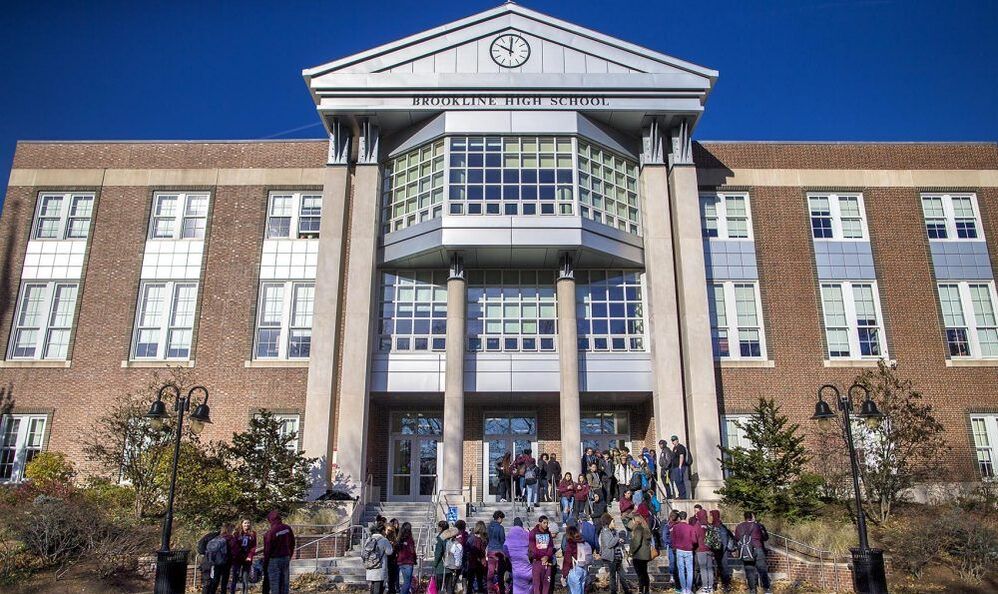
Cuts to teaching positions coupled with a spike in student enrollment have caused some Brookline High School class sizes to balloon as high as 35 students and prevented some students from taking certain courses entirely, according to administrators, teachers, and students.
Upper level — honors, advanced, and advanced placement — core-subject courses for juniors and seniors have been most affected because school leaders prioritized keeping standard-level courses smaller, Head of School Anthony Meyer said in an interview with Brookline.News last week. The math, English, and world language departments have the highest percentage of courses over 25 students, Meyer said.
In a school district that prides itself on small class sizes and access to an array of courses, the widespread issues have come as a shock to students, parents, and members of the School Committee and added significant work to teachers’ and guidance counselors’ plates.
The problems stem from a staff that effectively shrank by the equivalent of about five out of approximately 330 full-time positions at the same time as the student body increased approximately 4%, from 2,087 students last year to an estimated 2,178 this year, according to Meyer and data provided by the district.
The equivalent of about three of the five positions were cut due to an anticipated $1.85 million district-wide budget deficit announced in the spring, according to Meyer. Another two full-time-equivalent positions were reallocated to support teacher preparation time for two new courses and to staff programs previously funded by the high school’s Innovation Fund, Meyer said.
The district does not plan to hire additional teaching staff this year to address the class size and access challenges, in part because “such additions would cause many students to alter their schedules” several weeks into the school year, Meyer wrote in a weekly newsletter to high school families.
The combination of an enrollment increase and staffing reduction has pushed class sizes to 30 or more students in 20 out of approximately 800 course sections. Last year, there were only two sections that large, according to data provided by district administrators. One hundred twelve sections this year have over 25 students, compared to 84 last year.
Students have also reported being unable to take certain advanced placement courses because there are simply not enough spots, even with larger class sizes.
At last week’s School Committee meeting, member Mariah Nobrega called for a “forensic” review of the factors that caused this year’s large class sizes.
“There was no clear answer [in last week’s Curriculum Sub-Committee meeting] that I heard about how we got from numbers of prior years to this year,” Nobrega said.
Staff forced to adapt
Teachers and students are settling into a year of cramped classrooms, larger-than-normal stacks of essays to grade, and adaptation.
Spanish teacher Erica O’Mahony, whose sophomore advanced classes have 30 and 29 students this year, has had to adjust in multiple ways.
In the classroom, a common speaking activity she relies on no longer fits the physical space. Instead of placing students in two lines across the middle of the room, an arrangement that allows for quick transitions between speaking partners, she has been forced to rely on electronic partner generation, which requires more transition time.
Outside of class, O’Mahony is spending additional time grading nearly 50% more students’ work than usual.
“I’m not going to stop working for my students,” she said. “But I worry that this is going to become the new norm and that teachers will burn out.”
The chaos of troubleshooting scheduling issues has also fallen on guidance counselors’ shoulders.
Guidance counselor Eric Schiff, who has been at the high school for 23 years, said this year’s scheduling issues are the worst he has seen.
As a result of the increase in student enrollment, guidance counselors’ caseloads have also expanded, from approximately 185 to 205 students, according to Coordinator of Guidance Darby Neff-Verre.
“Our twelfth grade counselors are really feeling it,” Neff-Verre said.
Students deal with scheduling uncertainty
For some students, the limited course space has manifested in a form of scheduling purgatory, where even a month into the school year, schedules are not completely set.
Junior Milo Dantowitz, who plans to pursue a career in medicine, signed up to take advanced placement chemistry, but learned he had been placed on a long waitlist at the start of the school year.
Over the frenzied first weeks of school, he communicated with his guidance counselor and the science department curriculum coordinator about a way into a chemistry class as other students dropped out or shuffled to other sections. As his prospects dimmed, he at one point inquired about the possibility of taking advanced placement physics instead, but that course, too, was full.
As of early October, Dantowitz had still not officially been told there is no spot for him in AP chemistry this year, but he had become resigned to that reality and instead filled his schedule with electives in drawing and medical careers. He said he will try to take a science course at a local college during the spring semester.
Addressing concerns that failure to take the most rigorous courses will hurt students in the competitive college admissions process, Neff-Verre said that guidance counselors will explain the high school’s scheduling limitations to colleges in their recommendation letters on behalf of students.
Meyer said he intends to work with other district leaders to ensure that this year’s issues do not become the norm. He wants the district to establish a formula that more directly ties allocation of teaching positions to student enrollment.
“There needs to be something predictable and clear that can help us plan and prevent what happened this year,” Meyer said.