

After his father died in 2023, Jonathan Mande borrowed some equipment from Brookline Interactive Group, the town’s nonprofit community media hub, to film and photograph the funeral.
That experience provided a creative outlet that changed Mande’s life.
“It became a source of healing for me. I would go on long photo walks,” said Mande, who is now working on a series about mental health issues among Brookline students.
Mande is one of the many Brookline locals who access BIG’s high-tech cameras and training that allow residents to take on ambitious projects and learn new skills.
BIG, founded in 1982 as part of a wave of new public access TV stations, also live-streams and records Select Board, Town Meeting and School Committee meetings, a service that took on added importance when the pandemic forced those sessions to go remote.
Its nine staffers also lead regular youth and adult education programs, and have experimented in recent years with new civic-focused initiatives such as a community listening project, as well as making virtual reality and other technology available to members.
But all of that could be at risk. The organization faces a financial crisis that Executive Director Jessica Smyser calls “existentially threatening.”
Like many cable access stations around the country, BIG has seen revenue from cable franchise fees plummet with the rise of online streaming. In addition, federal Covid relief money, which helped BIG survive the pandemic and grow, is set to run out.
In the face of those challenges, Smyser, who was hired in May, has a plan: She hopes that attracting more donations, charging for professional services and potentially securing more support from the town will help give BIG a firmer financial footing.
Scary, “existentially threatening” numbers
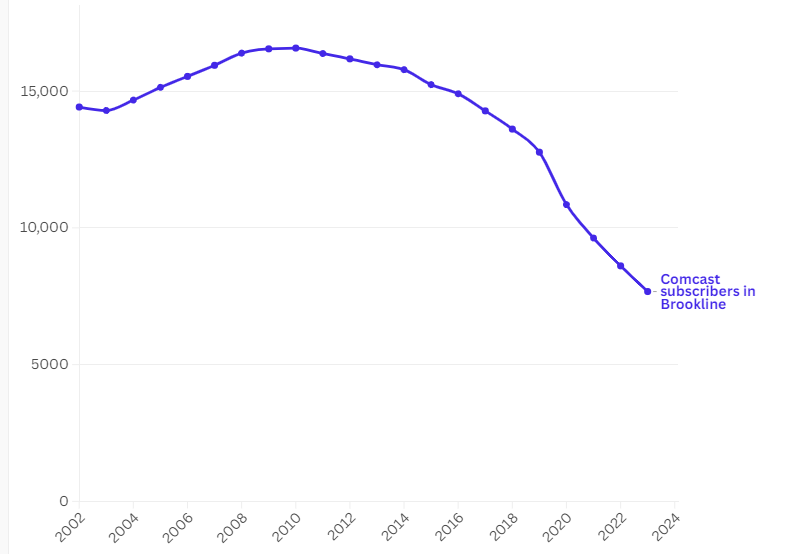
In 2016, Comcast had almost 16,000 cable subscribers in Brookline, according to state data.
By 2023, there were only 7,600.
“Those numbers are scary,” Smyser said. “They are existentially threatening.”
That’s because for decades, many public access TV stations, including BIG, derived most of their revenue from cable franchise fees.
Federal law requires cable providers to compensate municipalities up to 5% of the revenue they get for operating in a city or town. Municipalities then pass on a portion of those proceeds to local access TV providers such as BIG.
The trend of “cord cutting,” as Americans turn away from cable and toward digital TV subscriptions in large numbers, has cut deeply into that revenue.
Comcast subscribers in Brookline, 2002 to 2023 (data via state records)
BIG received a major lifeline in 2022: $900,000 in federal American Rescue Plan Act (ARPA) Covid relief funds, distributed by the town. But the money was significantly less than the $6 million that BIG requested, and came with a catch: It must be spent by 2026.
“The ARPA grant is a wonderful thing, don’t get me wrong,” Smyser said. “But it kind of masks other financial issues.”
Smyser, who most recently led Cambridge Community Television, BIG’s counterpart in Cambridge, has ideas for how to move the organization forward.
First, she wants to beef up some nonprofit basics that she says have been neglected over BIG’s history. This includes building a donor database and preparing to solicit and receive more donations from individuals and foundations.
She also wants BIG to start offering professional services, charging companies or nonprofit organizations to come and learn how, for instance, to create a public service announcement.
The third prong of Smyser’s plan is to work with the town, although she stresses that BIG values its independence and does not want to be seen as an arm or agency of the town.
Currently, the town sends BIG $40,000 a year in exchange for the services it provides for streaming various town meetings – a fraction of what BIG staff say it costs to provide those services. That is in addition to the $120,000 that BIG gets annually from the town’s franchise agreement with Comcast and RCN.
Brookline will be renegotiating its deal with Comcast in the next few years, and with that, Smyser says, may come a new deal for BIG.

A vision for growth
Board President Eric Hyett came in the door like most people who get involved with BIG, looking for a creative outlet and a venue for a project. In his case, a writing class for storytellers turned into a TV show.
“It was the space itself that drew me into BIG,” Hyett said of BIG’s office at the high school. “I don’t know of another space in Brookline that’s intergenerational in that way, well-managed in that way, and has a creative purpose.”
Over the past few years, Hyett said he’s seen great positive change in BIG’s programming.
“The programming has been so fun and diverse,” he said. “The pandemic led people to want to create new content.”
“It’s a place for under-represented people in the community to see the democracy of having the airwaves at their disposal,” Hyett said.
As board president, Hyett is aware of BIG’s financial plight.
“I think it’s my job, together with every other board member, to start to state the value of this organization to the community, and hopefully people will want to buy memberships and get involved,” he said.
Moving forward, Smyser’s new ideas include having BIG provide more podcasting equipment and space as well as video game development education.
Hyett wants to significantly increase the organization’s ability to produce content in languages other than English and grow its staff and board.
For Mande, BIG is a “quiet pillar of the community.”
“BIG is kind of like the mellow student that does good work, but is forgotten by the teacher, because the teacher’s paying attention to the louder kids,” he said.
Editor’s note: This story has been updated to include more details about the funds that BIG receives from cable franchise fees.