
Some kids grow up peddling cold drinks on a summer day. Owen Bergstein was a little different.
“Almost as long as I can remember, I was making crossword puzzles with pen and paper and selling them on the street corner for 50 cents,” the 16-year-old Brookline resident said. “That was my lemonade stand.”
Meanwhile, Adam Doctoroff, a nationally-known crossword puzzle solver, looks forward to his semi-regular run-ins in the Washington Square area with Brendan Emmett Quigley, a renowned crossword constructor.
This town boasts a vibrant multi-generational crossword puzzler roster. Is it a coincidence, or something else?
A Brookline quintet — Doctoroff, Bergstein, Marie DesJardins, Marla Choslovsky and Hongi Yu — represented the town at the American Crossword Puzzle Tournament last month in Stamford, Connecticut.
“I actually don’t think it really struck me how much of a hot spot Brookline is until the most recent tournament when they gave competitors a list of names,” said Bergstein. “There were so many people from Brookline.”
Doctoroff, 51, posted the highest score among all New England-based competitors and finished 11th nationwide in a field of 800. Bergstein, a Boston University Academy junior, ranked 19th in New England and 135th overall.
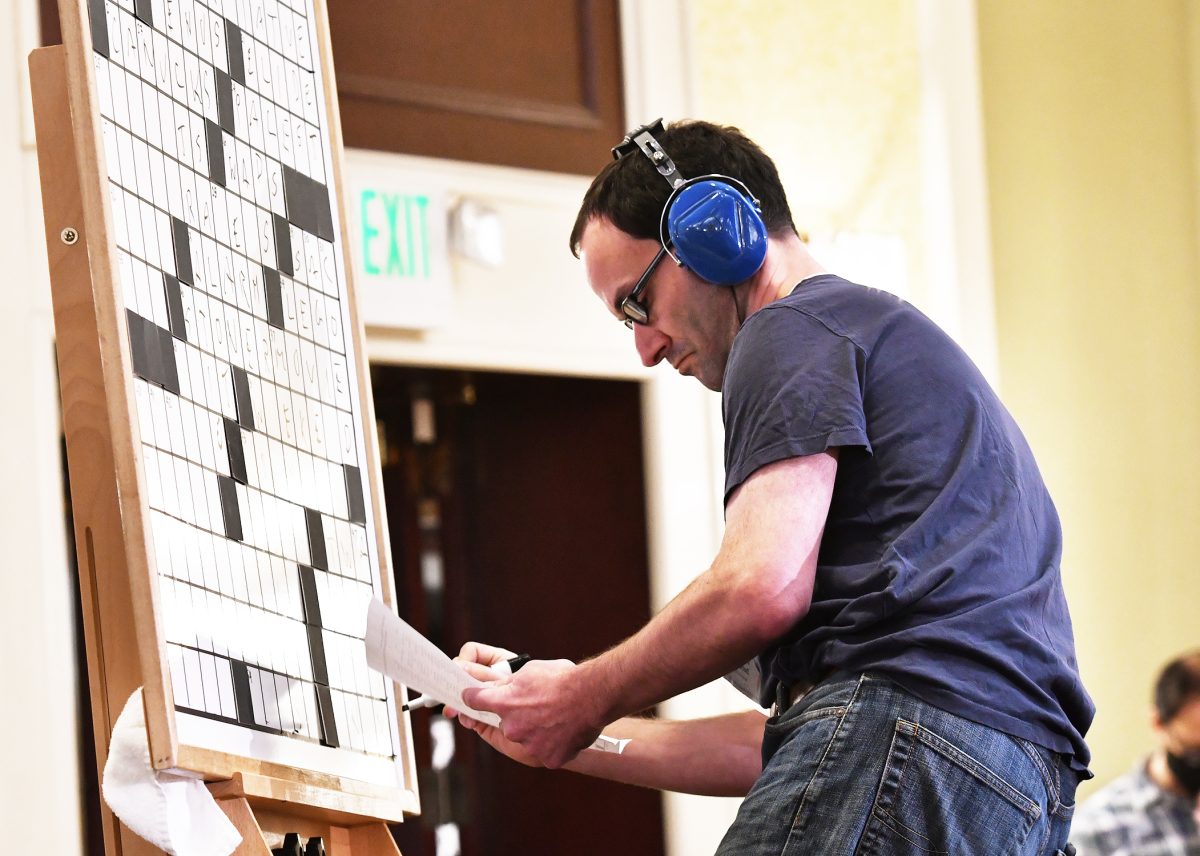
At the two-day weekend tournament, competitors spread across the Stamford Marriott Hotel ballroom and race to solve puzzles. Scores go online in near real-time. Finalists solve on large easels surrounded by cameras.
A full-time puzzle maker, and a top level puzzle solver
A lifelong Massachusetts resident who moved to Brookline in 2013, the 51-year-old Quigley likened his taking to puzzles at a young age to athletes who start their sport early.
“Puzzle people tend to be pre-programmed to be puzzle types,” he said. Quigley sold his first crossword puzzle in 1996 and went full-time as a freelancer in 2001.
The key to creating a puzzle, Quigley said, is to lean into a theme found in language. Puzzles, including those he publishes in the New York Times, Washington Post, Wall Street Journal, Boston Globe, Los Angeles Time Syndicate and many, many more, shouldn’t be impossible to solve.
“You try to find that kernel of what that might be and answers that fit that criteria,” Quigley said. “It may be difficult and take some time, but you do want them to eventually get it.”

Oftentimes Quigley crosses paths with Doctoroff, a Brookline resident since 2002 who runs a private equity firm.
He started solving puzzles in Games Magazine and New York Times as a pre-internet youth, and after a decades-long hiatus, returned to regularly solving puzzles again about 15 years ago.
Doctoroff’s best-ever finish in the American Crossword Puzzle Tournament was eighth. He won Boswords, a Boston-based tournament, in 2023 and finished second in 2024. Crossword puzzle solving isn’t a professional career in the sense of money making – the top division winner in the American Crossword Puzzle Tournament takes home $7,500 – but tournaments turn a hobby into competition.
“When you’ve been doing it for a while you know all the fast people,” Doctoroff said. “The puzzles at tournaments are really, really good, so you’re solving good puzzles and it’s very gratifying to be fast at something.”
Doctoroff prefers solving crossword puzzles alone on a computer in his bedroom.
He churns through about eight every day, from a variety of online sources, including the New York Times, Los Angeles Times, Wall Street Journal, New Yorker and Boston Globe. He tackles Quigley’s each Monday and Thursday soon after they come out.
Starting young
Bergstein got the crossword bug from his parents, especially his mother, whom he competes with each morning for the rights to complete the daily New York Times puzzle in print.
He has also dabbled with creating his own puzzles, publishing his first in The Modern, the Puzzle Society’s crossword feature, and also in the York Times and LA Times. He isn’t sure what he wants to study in college yet, but hopes to keep the crossword puzzle constructing thing going on the side.
Choslovsky, whose day job is as the Director of Development at MIT Hillel, remembers doing her first crossword puzzle in the Chicago Tribune when she was 11.It soon became a weekly habit with her father. Now 62, Choslovsky does most of her puzzles on the computer, mostly in the New York Times, but goes back to doing them on paper a month before any tournament.
Inspired by the 2006 documentary “Wordplay,” Choslovsky has competed in the tournament 11 times. She loves the chance to experience camaraderie in what is otherwise a mostly solitary activity.

“The first year I went into the ladies room and I didn’t see women primping, I saw them sharpening their pencils, and I think I found my people,” Choslovsky said. “There’s a lot of energy around something I love to do with people who share an interest with me.”
Wordplay is about Will Shortz, the founder and director of the American Crossword Puzzle Tournament, who called the crossword community a “broad-based group.”
This year’s American tournament participants ranged from teenagers to a 99-year-old. A lack of youth interest was a concern, said Shortz, who has published crosswords from more than 60 teenagers in The New York Times, where he is the crossword editor
Puzzlers tend to be smart, well read with quirky minds, are good spellers and are interested in the world,” said Shortz. “It’s more of a meeting of types of minds rather than the subject itself that brings people together.”
Brookline’s crossword puzzle players rarely, if ever, gather together on purpose to solve puzzles, but seeing familiar faces at tournaments or in online communities always piques attention.
“It definitely makes it feel like a small community,” Doctoroff said. “When you go to tournaments and other places and see names from Brookline, it’s always fun.”