
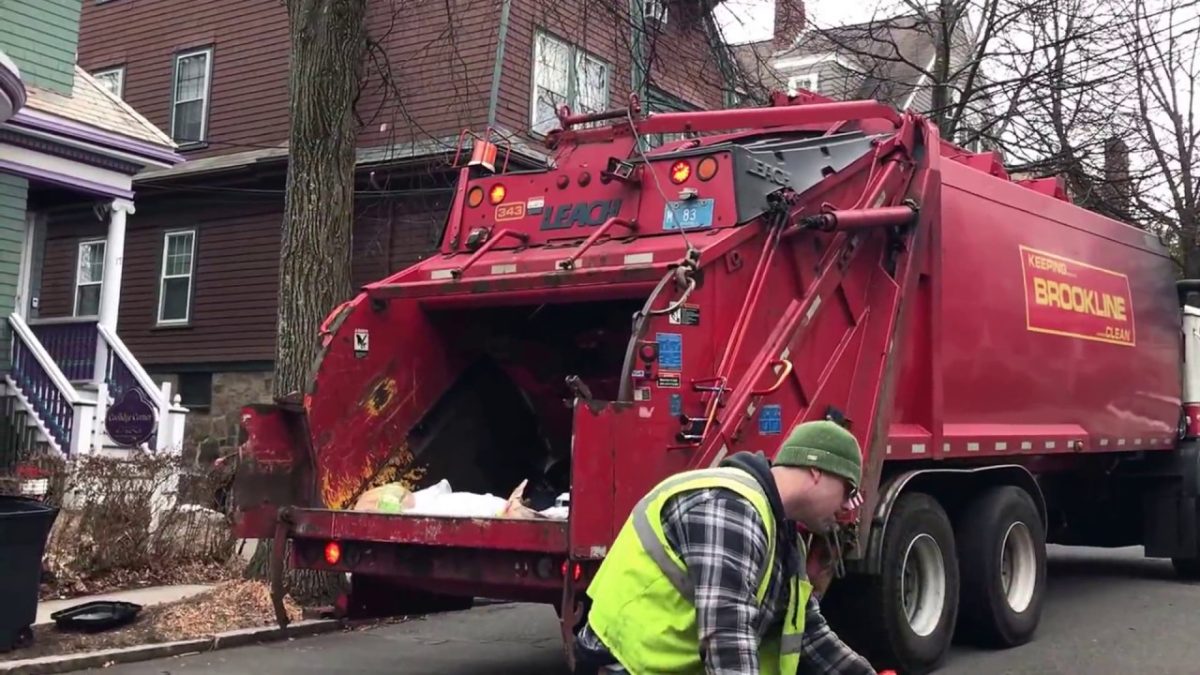
In an effort to stave off a crisis caused by issues with staffing and vehicle maintenance, the town on July 1 will turn over curbside trash collection to a private company, Casella Waste Management, under a five-year, $26.3 million contract that the Select Board unanimously approved at its January 14 meeting.
The board also okayed a 10-12% increase in the fees that residents pay for waste collection.
“We currently have a model that is positioned to fail, and we are really looking to make sure we can provide this critical service to the town,” Erin Chute, commissioner of Brookline’s Department of Public Works, told the Select Board.
No DPW employees will lose their jobs as a result of the change, she said. Sanitation workers will have the option to transfer to other positions in the department.
Jim Durkin, legislative director for AFSCME 93, the union which represents sanitation workers and other municipal employees in Brookline, said that he believes the town and union have done “everything they could do, at least in the short-term.”
“We never like to see government work handed over to a private contractor, but this is not the typical privatization fight we get into with municipalities that are trying to save money,” he said.
The move puts Brookline in line with the practices of most municipalities in Massachusetts. It is one of only 11 cities and towns statewide that use their own workers and trucks to collect residents’ trash, according to Chute.
Finding and retaining trash collection employees has been difficult for the town, Chute told the board. Those workers, she said, can often earn more working for a private company than in municipal positions.
“We are struggling every day to fill the seats to drive and collect trash,” she said.
Casella, the company awarded the contract to collect trash from more than 13,000 Brookline households, currently has a smaller contract to collect residents’ recycling and haul Brookline’s waste from the transfer station on Newton Street to a landfill. That existing contract ends on June 30.
Under the new contract, Casella will add curbside trash collection for residents to its responsibilities, further privatizing the process in Brookline. The only curbside collection that will still be made by the town is for yard waste.
For fiscal year 2026, town leaders estimate the full cost of sanitation services, including the new Casella contract, will be $6.68 million, which is about $60,000 more than what they estimate total costs would be if trash collection was kept in-house.

Casella, which started as a local business in Vermont in 1975, is now a national company with around 5,000 employees, and its clients include a number of other municipalities in Massachusetts and other New England states.
“We’re really excited to continue partnering with Brookline,” said Jeff Weld, the company’s vice president of communications. The recycling contract first started a decade ago in 2015.
“Our goal, whenever we take over a municipal contract like this and start to service a community, is to make sure that change is not something that is highly visible,” Weld said. “Ultimately people don’t want to have to worry about this.”
Staffing and fleet are major challenges
Of the nine positions in the sanitation department, only four are filled with full-time staff currently, and one of those employees is on extended leave, Chute said. In order to pick up trash every day, DPW is often forced to pull employees from other divisions.
“This has had a really negative impact on morale, from employees who are shifting over to sanitation, which is not the trade or service they were originally hired for,” she said.
Five workers have resigned from the town or transferred to other divisions within the past year because of the trash collection issues, Chute said.
The job can be dangerous. In the past four years, the town has had 23 workers’ compensation claims associated with waste collection, 12 of which have led to a total of 1,159 lost days of work, according to Chute.
However, some of the town’s sanitation employees are disappointed by the decision, according to John Dempsey, chair of the town’s Solid Waste Advisory Committee. Two of them came to the committee’s most recent meeting in December to “state their case,” he said.
“They felt that the town should keep it in house. They know the route, they’ve been doing this for years. They provide good service,” he said.
Ultimately, Dempsey and the committee supported the change, but it came with some “sadness,” he said. The town’s sanitation workers have given “really good service,” taking on other duties like driving snow plows during storms.
“We see the employment situation and the other concerns that the commissioner has, and just regret that the time has come to outsource the service,” Dempsey said. “We were able to stave it off for years, but it was inevitable to head in this direction.”
The town’s fleet of so-called “packer” trucks is also banged up: In the past year, the town had more than 124 repair tickets, Chute said, which led to service delays. Over the next seven years, it would cost an estimated $2.4 million to replace the existing trucks, she said.
With the new contract signed, the town plans to auction or sell those trucks for revenue.
Fees set to increase
The fees paid by residents are also set to increase on July 1 as the new contract goes into effect.
For residents using a 35-gallon trash cart, the annual cost will go up from $250 to $275. 65-gallon carts will increase from $336 to $373 and the largest 95-gallon carts from $425 to $476.
“The sanitation program relies on revenue generated by the refuse fee to offset a portion of the total cost of solid waste collection and disposal,” Chute said. The fees were last increased in 2023.
