
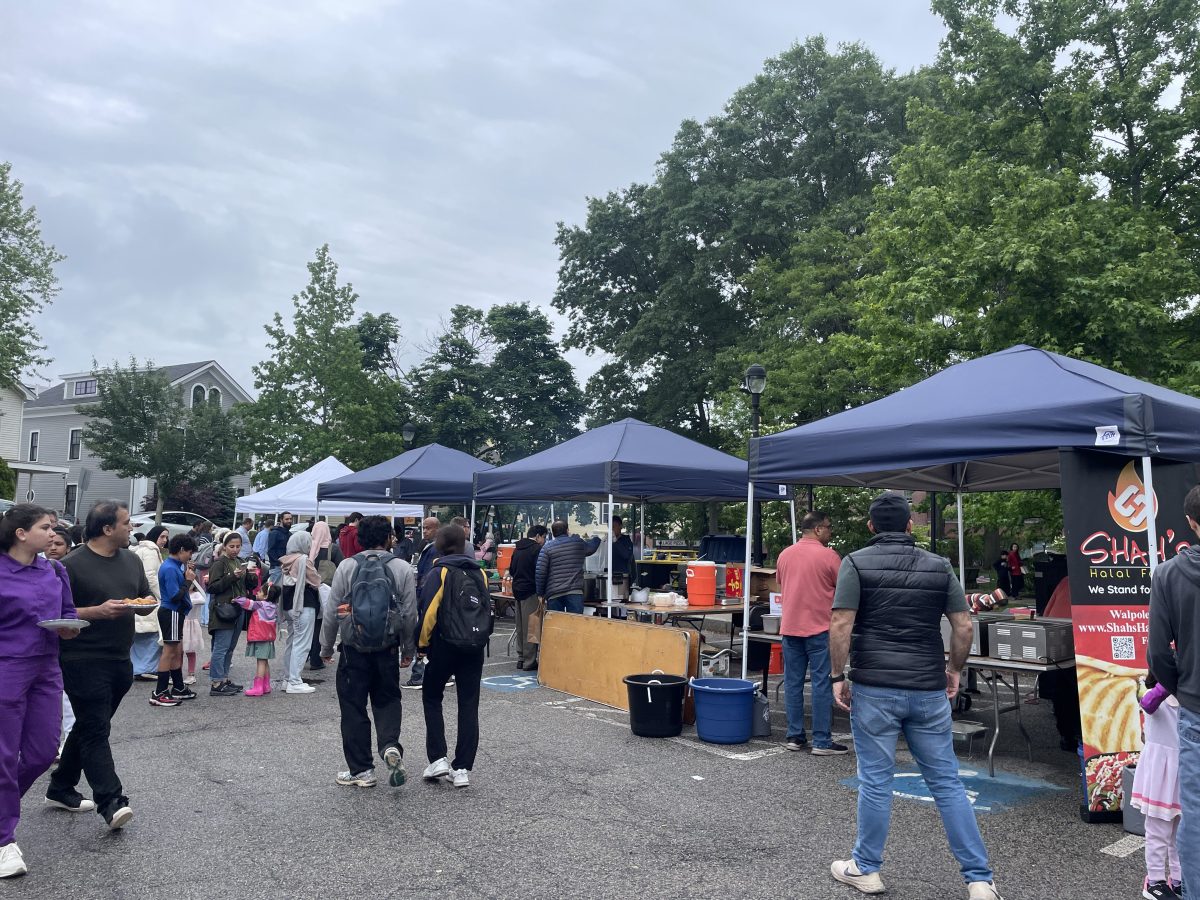
On a rainy Saturday afternoon, the smell of kebabs and samosas wafted through the air outside town hall.
At Brookline’s second annual Eid Fair, locals and out-of-town visitors celebrated Eid al-Adha—-the holiday marking the end of the Hajj pilgrimage to Mecca—with traditional food, music and Islamic art. Brookline Muslim Friends hosted the festival, officially sponsored by the town’s Office of Equity, Diversity, Inclusion and Community Relations.
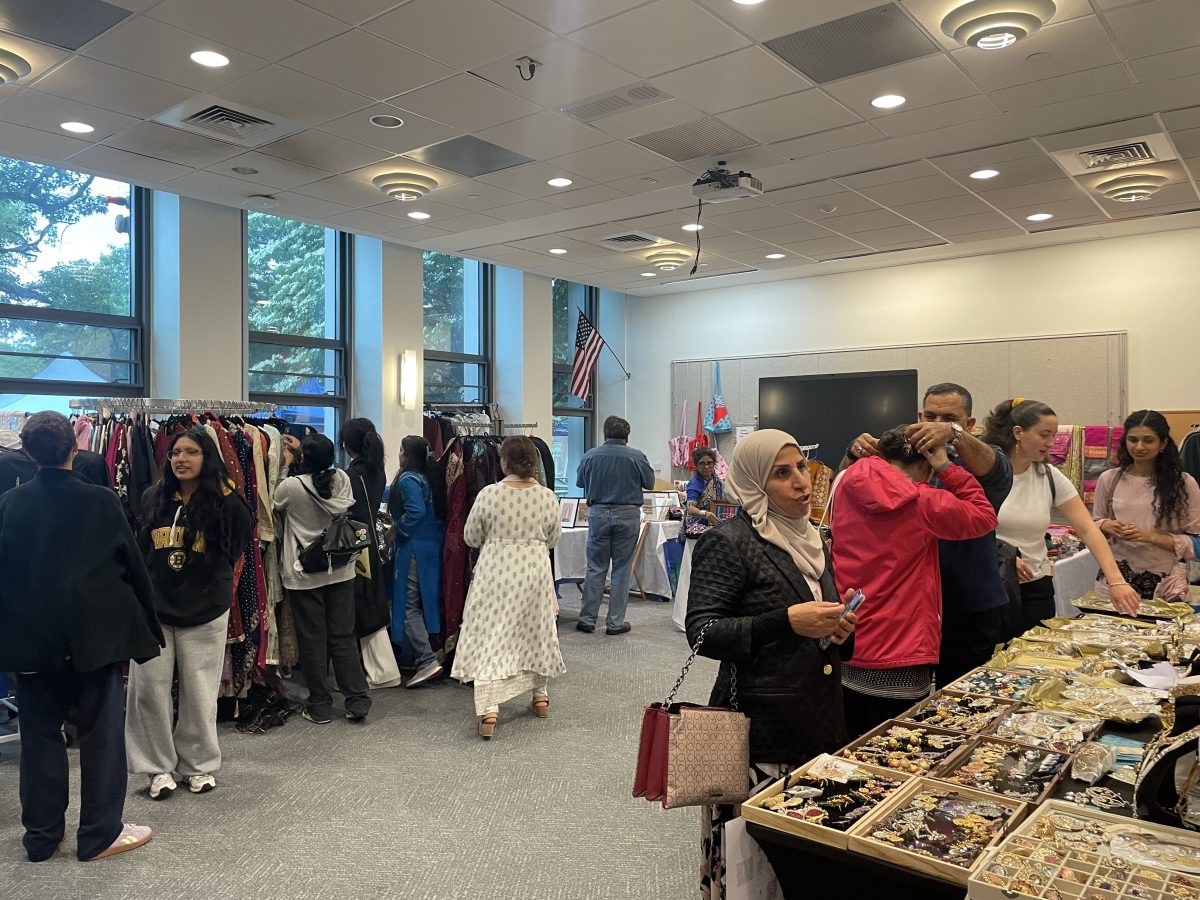
“I love to see Muslim representation in Brookline. I went to school here, and I’ve never seen anything like this before. So it’s exciting,” said 24-year-old Nada Alaeddin, browsing the indoor clothing and jewelry displays.
Eid al-Adha, which falls on the tenth day of the final month in the Islamic calendar, coincides with the end of the school year and the start of summer.
“It’s a beautiful moment to have the festival,” said head organizer Sana Haroon.
Inside racks of traditional Islamic dress and art showcases filled the rooms. At one stand, artist Hajj Wafaa inked the names of a Brookline couple, ShanShan Guo and Quintin Boger, in Arabic calligraphy.
Wafaa fell in love with calligraphy as a young boy watching his uncle practice the craft in Kufa, Iraq.
Kufic, the oldest style of Arabic script, is named after the city, he explained.
“Oh wow, that’s really beautiful,” Guo remarked, looking at the finished product.
Across the way, 19-year-old Sheema Rizvi, who started her own Henna business at the age of 16, traced designs on the hand of a child seated across from her. “We mostly do Henna before Eid. We do it for happiness and beauty for women. Before a wedding, the bride gets Henna from her elbows to her hands,” she said.

As the organizer, Haroon described the fair’s purpose as two-fold.
“We wanted to bring the Muslim community together in celebration but also showcase to our friends, our neighbors around the town and around Boston, the richness, beauty and joy in Muslim cultures,” she said.
Outside the town hall entrance, families holding umbrellas lined up to receive a warm cup of chai.
The black tea unites Muslims of different ethnic backgrounds, said Imtiyaz Hossain, who co-founded Mezbani Chai House with his wife.
“Chai, specifically, is one of the staples that you have at any sort of gathering,” he said. “If you don’t have chai, it feels like there’s something missing.”
By mid-fair, they had sold out of their offerings. “When it rains, people crave chai ten times more,” he said.
Food vendors also served up dishes from North African, Central Asian, and Middle Eastern cuisines in tents outside.
Kurban Hasan, co-owner of Silk Road Uyghur Cuisine, described Uyghur food as a unique blend of Chinese, Central Asian, and Turkish influences. “And it’s also halal, ” he added, meaning that the food is prepared following Islamic dietary laws. The most popular dish on the menu that afternoon was a cumin beef stir-fry.
Faiza Khan, a member of Brookline Muslim Friends who helped organize the event, said that one of her goals was to display the plurality of ethnic backgrounds within the Muslim community.
The food and culture in one Islamic country can look very different from those of another Islamic country. “It’s not all the same. There are many colors. So through this event, we wanted to highlight this,” Khan said.
Last year’s fair came at a time of lingering sensitivity around outside perception of the Muslim community, Khan recalled. She was among Muslims who shared with Brookline.News that they experienced feelings of isolation in Brookline during the devastating conflict that followed the Hamas attack in Israel on Oct. 7, 2023.
At this year’s celebration, she described a bright mood among organizers, who were pleased to see a high turnout of “people from different cities, Muslims and non-Muslims.”
Tomas Drgon, a data scientist for the Federal Drug Administration and a friend of Haroon, happened to be visiting from Washington, D.C for a music workshop. Having received a music degree in his home country of Slovakia, he offered to DJ for the event.
“The perception [of Muslims] is shaped by pictures of war zones. You very rarely see just normal human relations in the Arab context, without any subtext, or necessarily any other message,” said Drgon, who is not religious himself.
As media coverage of the war in Gaza continues, Drgon said he felt festivals such as the Eid fair were important to “show the culture in a non-news sort of a context—the language, the music, the food.”
In a unique set-up, he used a potted plant to power his soundboard, producing a set of music rooted in the “Lower Danube music tradition,” which he described as mixing Ottoman and Balkan influences.
Nearby, kids played and explored the fair. Twelve-year-old Nour Moussa had arrived after a soccer match and pointed excitedly with a hand covered in Henna at her best friend.
“My best friend who’s here—she’s not Muslim—it’s so great that I get to share this with her,” said Moussa, smiling.