
If you’ve been to Brookline Booksmith, you might have seen bread for sale that says it was made at the Holy Transfiguration Monastery.
What are monks doing in Brookline – and why do they make bread? Brookline.News set out to find out.
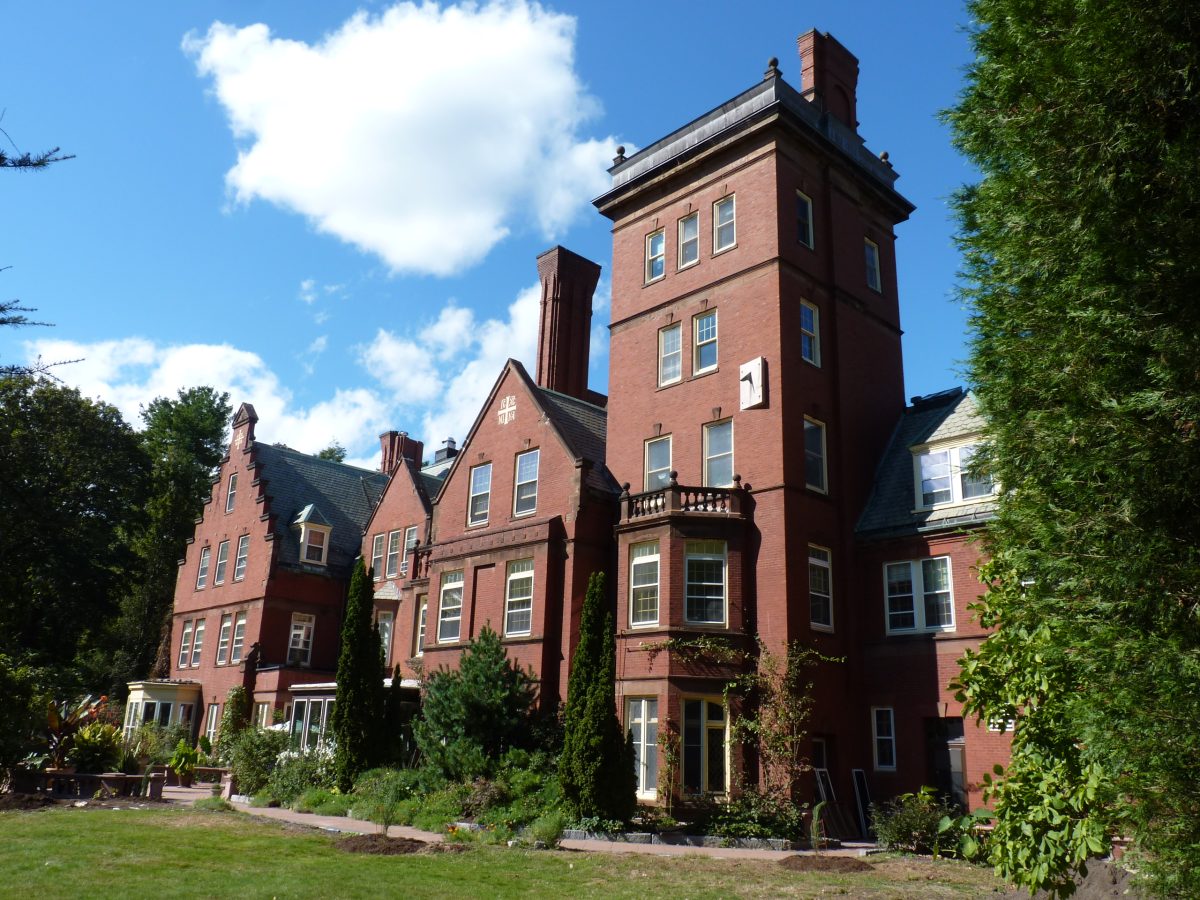
Holy Transfiguration, at 278 Warren St., is an Eastern Orthodox monastery that’s part of the Holy Orthodox Church in North America, a jurisdiction based in Roslindale.
The monastery is home to 18 monks, four of whom are priests.
It was founded in 1961 by Father Panteleimon. He grew up in Detroit as the child of Greek immigrants, and as a young adult entered a monastery on Mt. Athos in Greece. When monks there suggested he go back to the United States to start a new monastery, he chose Boston because of its proximity to Hellenic College, the Greek Orthodox seminary.
The monks quickly outgrew their house in Jamaica Plain, and by 1969 they were looking for a new home, according to Father George, one of the present-day inhabitants of the monastery.
One day they went up the driveway of 278 Warren Street, and were surprised to see a nun at the house, which turned out to be a Roman Catholic convent. Father Panteleimon asked if they had any interest in selling, and the nun said they did not.
But a month later, he got a phone call. The nuns had decided there were no longer enough of them to justify having a 52-room convent, and they were willing to sell to this fledgling Orthodox monastery. Holy Transfiguration Monastery has been there ever since.
Walking up the driveway to the monastery, it’s easy to forget that it’s located less than two miles from the hustle and bustle of Cleveland Circle. The monastery sits on 17 serene acres of land, with grounds designed by Frederick Law Olmsted for the property’s original genteel owner.
Another previous owner was Scottish, who refurbished the interior to look like a country estate from his homeland, with lots of ornately carved dark wood. Today, the room designed to be the ballroom is the monastery chapel, filled with Orthodox icons and candles, which illuminate the room exclusively — no electric light.
The monks are in the chapel at 3:30 a.m. every day for prayers. They have numerous prayer services throughout the day, as well as Divine Liturgy, a service of Holy Communion. On Sundays, local Orthodox practitioners join them for worship. While initially the services were held in Greek, today they are mostly in English.
Why bread?
Outside of the main rooms of the first floor there are numerous workshops and storage spaces for the production of various items, including the now-famous bread, which is for sale at Brookline Booksmith.
“It’s a traditional recipe from Asia Minor,” the Turkish region also sometimes known as Anatolia, said Father George, who gave Brookline.News a tour.
For decades, the monks gave out their bread at Christmas and Easter, but more recently, friends suggested they sell it. Initially, the monks were unsure. “Who’s going to buy sweet bread all year round?” they thought. As it turned out, quite a few people; the first batch sold at Brookline Booksmith went quickly.
Peter Win, one of the owners of Brookline Booksmith, said the bread has continued to sell well.
“I think it is nice to have this kind of local partnership with the Monastery,” Win said.
“The fact that we are the only other place one can buy it makes it a little more special, and the extra attention it has brought over the years has been great as well. Most of all, the bread is really good.”
The rich bread is reminiscent of challah, with sesame seeds and a secret spice blend on top.
Beyond the bread
Despite its celebrity status in Brookline, the bread isn’t actually the monastery’s main production. The monks also make three other products: translations of religious texts, incense and icons.
Many Orthodox religious texts are in Greek, or other languages of the Near East and Europe, such as Syriac and Russian. The monks have translated numerous religious books into English.
The incense is used in Christian churches as part of the worship service. It starts out as bags of frankincense from the Horn of Africa, which is then ground into a sand-like consistency. At the Brookline monastery, the monks mix it with oils, cut it into small pieces, and then dry it for six months.
They also create icons — images of Jesus Christ or a saint — which Christians often use in prayer.
While hand-painted icons are beautiful, they are also extremely expensive, costing potentially thousands of dollars. The monks mostly take painted icons made by nuns at the nearby Holy Nativity Convent, scan them, print out copies, laminate them, and mount them on wood. A more affordable option than hand-painted icons, there are now Holy Transfiguration Monastery icons in churches all over the world.
“I think one of our strengths is people come here and see an icon they recognize from their hometown,” said Father George.
A sweet life
Being a monk can be challenging, and outsiders often wonder what the appeal is. But for Brookline’s monks, they wouldn’t want to do anything else.
“It’s about living a life of repentance, for their own sins and others,” said Father George. And luckily for Brookline residents, it also involves making delicious baked goods.