
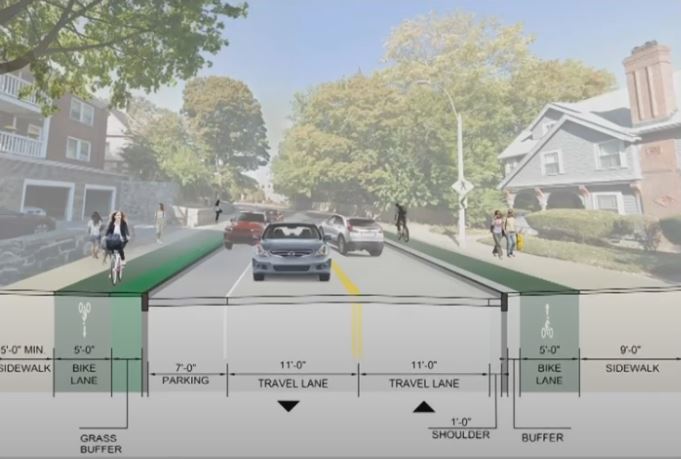
A plan for a massive reconstruction of Washington Street between Beacon Street and Route 9 is slowly moving forward, amid tensions between prioritizing bicycle safety or parking.
One of the largest and most controversial changes as the plan now stands would put a curb between bicycles and cars by adding sidewalk-level separated bike lanes to the corridor, which proponents say would be a major upgrade to bicycle safety on the heavily-traveled street.
To make room for the separated bike lanes, the design would remove dozens of public on-street parking spaces, a loss that local businesses from Washington Square to Brookline Village fear could be devastating.
“The process we’ve gone through is one of tradeoffs between all of those tensions to try and find a compromise that works well enough for all the parties,” said Brian Kane, who chairs Brookline’s Transportation Board. “I’d like to tell you that everyone is ecstatically happy, but they’re not.”
The design of the project, which has been evolving for several years and is not likely to break ground until 2028 at the soonest, also includes a full-depth roadway reconstruction, with new traffic signals and raised crosswalks, plus new pedestrian curb ramps. The $29 million project has been listed in the state’s Transportation Improvement Program, which puts it on track for potential funding by the federal and state governments.
“The primary goal of this project is not only to rehabilitate a critical arterial roadway that is in poor condition, but to create a true complete street throughout the entire corridor,” Brookline Commissioner of Public Works Erin Chute said at a public forum in November.

To David Kroop, president of Biking Brookline, the possibility of building protected bicycle lanes as part of a $29 million project paid for with state and federal funds is too big an opportunity to pass up.
If not now, “when would we ever do it?” he argued.
“Data shows that the rate of crashes on protected bike lanes is much, much lower than even on the painted and so-called buffered bike lanes like the ones we have on Washington Street today,” Kroop said. “It’s not only that the crash rate is lower, it’s also that the severity of crashes tends to be lower.”
Given the limited width of Washington Street, those lanes come with a price in the form of reduced parking.
There are now 199 public, on-street parking spaces on the 1.1 mile corridor. The current proposal would remove 64 of them, leaving 135, according to Public Works Commissioner Chute.
The original plan, she said, called for removing all Washington Street parking in Brookline Village. A design review committee commissioned for the project restored some parking after hearing complaints from the business community during its eight public meetings.
“The feedback from businesses was very clear and reasonable: We need parking and loading to stay in business,” Chute said.
Businesses, however, continue to worry about the loss of parking, said David Gladstone, chair of the board of the Brookline Chamber of Commerce.
“The business community are extremely concerned and scared about the negative impact that will occur with the removal of so many parking spaces,” Gladstone said at the November forum. Customers currently have to “work hard” to find available spaces, and the loss of parking would exacerbate that situation, he said.
“Our small businesses’ survival as locally owned entities are in the balance,” Gladstone said.
State funding at stake
While the project being placed in the state Transportation Improvement Program is a strong early indicator of eventual success, Brookline is still competing against 98 other communities that have also applied for funding, according to Transportation Board Chair Kane.
The inclusion of separated bicycle lanes, he said, could strengthen the town’s application, which must meet standards set by state policies on healthy transportation and complete streets.
“What our independent third-party, highly paid consultants have suggested, and what a reading of the regulations to my mind makes obvious, is that our project will score much better with continuous, protected bicycle accommodations than without them,” Kane said.
What’s next?
The design review committee is planning to hold its ninth and final meeting sometime in January, at which time it plans to vote on the design.
After that, the Transportation Board, which helps set local transportation policies, will take its own vote. Finally, the five-member elected Select Board will vote on the design.
Chute hopes those votes will take place in the first few months of 2025.
Next, the town will present the preliminary design (known as a “25% design”) to the Metropolitan Planning Organization, the regional planning organization that oversees the state’s Transportation Improvement Program budget. Town officials hope to have that completed well before the October 2025 due date.