

As dawn brightens in Quezalguaque, Nicaragua, cows meander through town to pasture. When dusk arrives, the cows return. Decades earlier, a teacher from Brookline gave one cow to the rural Nicaraguan school where she taught. The promise of milk for her young students marked the beginning of a lasting relationship. The two towns, almost four thousand miles apart, now boast 40 years of collaboration.
Born from one woman’s mission, the Brookline-Quezalguaque Sister City Project takes a personal approach to international aid. Since its founding in 1987, the group has worked to improve literacy, support public health, and invest in infrastructure in Quezalguaque, a small town on the western side of Nicaragua.
Now, the Sister City Project faces challenges in the U.S. and Nicaragua that could limit its work. Many items the organization sends to Quezalguaque, like ultrasound machines and blood chemistry tests, have to be purchased through Nicaraguan suppliers at costs that are much higher than in the U.S. These essential items sponsored by the group are subject to import fees, which could increase as economic relations between the U.S. and Central America grow tense under the Trump administration.
In Nicaragua, the government shut down thousands of NGOs and charity organizations in the past few years, some of them aid groups like the Sister City Project. Volunteers are careful to navigate these changing policies, but their visits to Quezalguaque have become less frequent.
And as the group’s core members are getting older, attracting new interest amid a political climate teeming with other causes proves difficult.
However, the Brookline group’s mission of interpersonal collaboration has not changed. “We were started to help the people, and that’s what we have to keep thinking about,” said Carol Piñeiro, the current president. “We just have to keep that focus.”
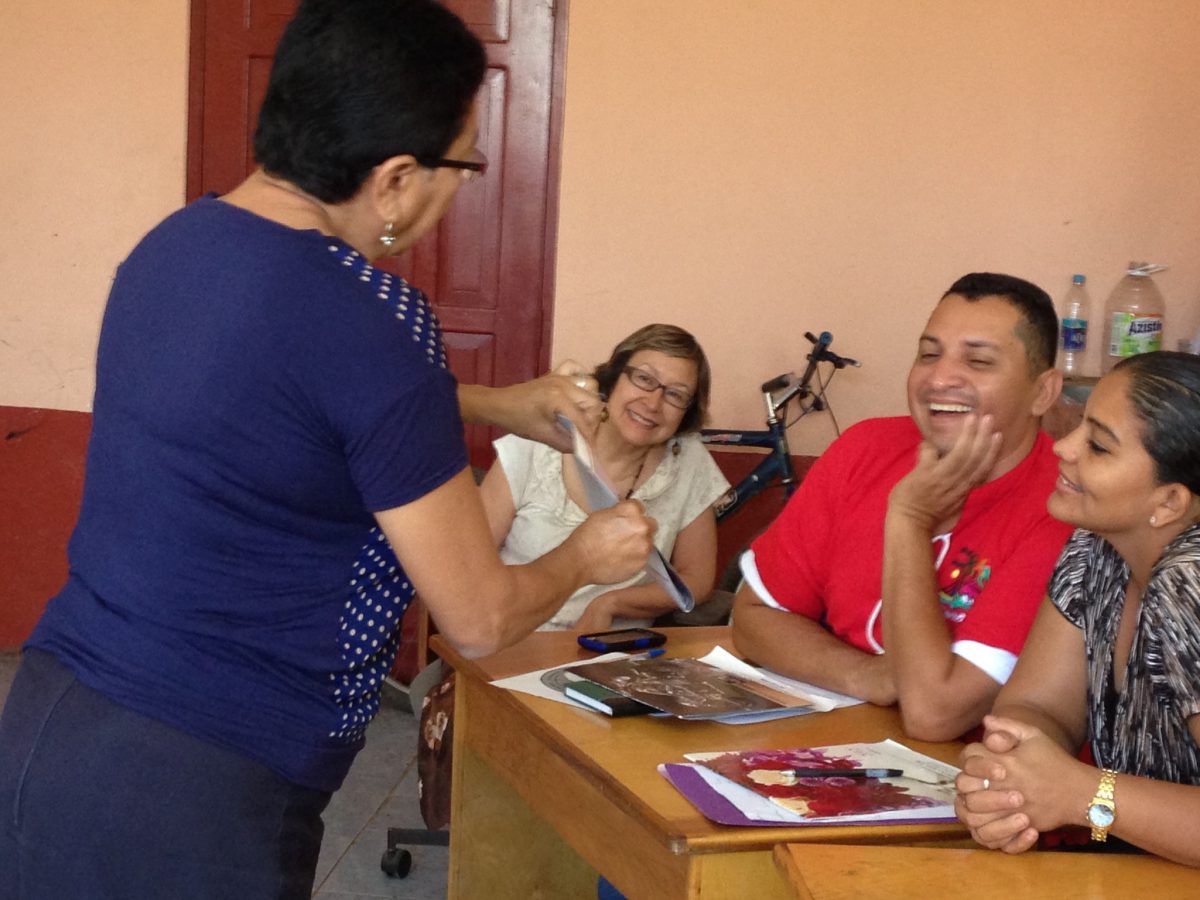
‘Fighting together for something good’
As political conflict swelled in Nicaragua during the 1980s, volunteers from around the world arrived in rural towns to help locals with the harvest. The country had experienced a decades-long revolution, the overthrow of a president, and continued battles between the socialist Sandinistas who took power and the right-wing Contras militia.
Foreign investments dropped, fighting destroyed local infrastructure, and tens of thousands of people lost their lives. The number of harvesters dwindled and Nicaragua’s major export crops like cotton and coffee diminished.
During this time, Maxine Shaw, then 39, left Brookline and traveled to Nicaragua to pick cotton alongside local harvesters. She was a Spanish-speaking teacher inspired to show her solidarity for the Nicaraguan people.
“I really believed we were making a difference,” Shaw said from her home in Florida. “I really believed that everybody was fighting together for something good, not fighting against anything, but fighting together to build something.”
Shaw returned to Brookline after working with the cotton brigade and living in a rural town near Quezalguaque. Back home, she hosted a Nicaraguan teacher visiting with a Central American teachers’ tour. The teacher stayed with her while he toured local schools, studying English-teaching techniques he could bring back to his town. He was also looking for teachers, telling Shaw, “We have 500 classrooms without teachers, come down and teach for a year.”
Shaw agreed and began teaching in a one room schoolhouse in Quezalguaque, a small town nestled between green plains and volcanic peaks 70 miles north of the country’s capital, Managua. Over the next two years, she urged people in Brookline to raise money and purchase different items for the community. They bought school supplies, a motorcycle for a teacher supervisor, and a school cow so Shaw’s students could have milk.
In 1987, votes by town meeting members and the board of selectmen in Brookline approved the official Sister City Project. Ever since, the group has held fundraisers, raised donations, and organized trips for over 250 Brookline volunteers to visit Quezalguaque. They built a library with thousands of books and multiple computers, established a clean water system with solar powered pumps, and partnered with the Boston University Public Health Department to send students to identify chronic illnesses in the community.
The Sister City Project works directly with the mayor’s office in Quezalguaque to decide each project and engage residents in the work. People from town were hired to help with the construction of the library and were trained to fix the new pumping stations, ensuring the projects could be maintained after volunteers left.
“I am very grateful with this idea, with this project they have been implementing here,” said Fabio Borda, a teacher born and raised in Quezalguaque, who spoke with Brookline.News in a virtual interview from his home.. “Quezalguaque is such a small town, it’s very, very poor. I consider we have been blessed through the Sister City Project here.”
Between visits to Quezalguaque, the organization makes donations to fund the health center and library, support student scholarships, and promote affordable housing. They also brought Nicaraguan teachers to Brookline to stay with volunteers and visit local schools.
“That was a very wonderful experience, and a unique experience,” said Borda, who visited Brookline in 2016 and 2017. “I have learned much about the way to teach English using technology, using different kinds of strategies.” These trips, combined with local training in Quezalguaque, were part of an effort to improve teaching techniques and encourage literacy.

Challenges for the partnership abroad, and at home
Other areas of life in Quezalguaque are harder to change. Of the approximately 10,000 residents, many are unemployed or have to travel to nearby cities for work. “Most of the people don’t have the opportunity to work here in Quezalguaque, they have to go outside of our community in order to look for different kinds of jobs,” Borda said. “The possibilities to work here… it’s very terrible.” Some people start small businesses in town, but generating income is difficult.
“There’s a saddle making place, where young men learn to make saddles. Or a couple of women have hornos, outdoor ovens, and they cook tortillas or bread,” Piñeiro said. “There’s the guy who comes by, the knife sharpener, and he has a bicycle and he sharpens your knife by turning the wheel of his bike.” The charm of the rural town attracts people from nearby cities like León who want to buy property and build summer homes. “The people from Quezalguaque are complaining because they say, ‘We’re paying the taxes, we live here, and they’re coming and they’re living off what we created,’” Piñeiro said.
The Sister City Project faces its own challenges at home and abroad. As the organization ages, maintaining engagement and support grows more demanding. In the U.S., nonprofits are reeling from recent executive orders threatening federal funding freezes and cancellations. Even for groups not impacted by these cancellations, community donations are stretched thin.
“There’s a lot of other magnets to attract people’s dollars, and so people sometimes don’t remember Sister City as much as we’d like them to,” Piñeiro said. “There’s still some interest, but there’s so many needs.”
With the rise of political tensions in Nicaragua, students and volunteers are also deterred from visiting Quezalguaque. “We haven’t sent [students] down because we think it’s a little dangerous for them as well as for the town members,” Piñeiro said. For an organization founded on interpersonal connection, this restriction is especially difficult. “A lot of us are getting older,” Shaw said, “And I think the way we got new young people involved was they went down there and fell in love with the town.”
In Quezalguaque, locals are eager to host students and visitors again, a testament to the sister city relationship. “I have been connecting with them, most of the time I communicate with them on WhatsApp,” Borda said, naming Piñeiro and other Sister City Project members. “I would like to see [them] again.”
Despite social and political obstacles, the Sister City Project is hanging on to its mission of person-to-person care. The group is planning a fundraiser for the evening of April 30 at the Brookline Teen Center.
“This is our house, this is our world, and we all live in it together. There’s no North or South or East or West,” Piñeiro said. “The more harmony we try to create, the better life will be for everybody, for the common good, the commonwealth.”
