
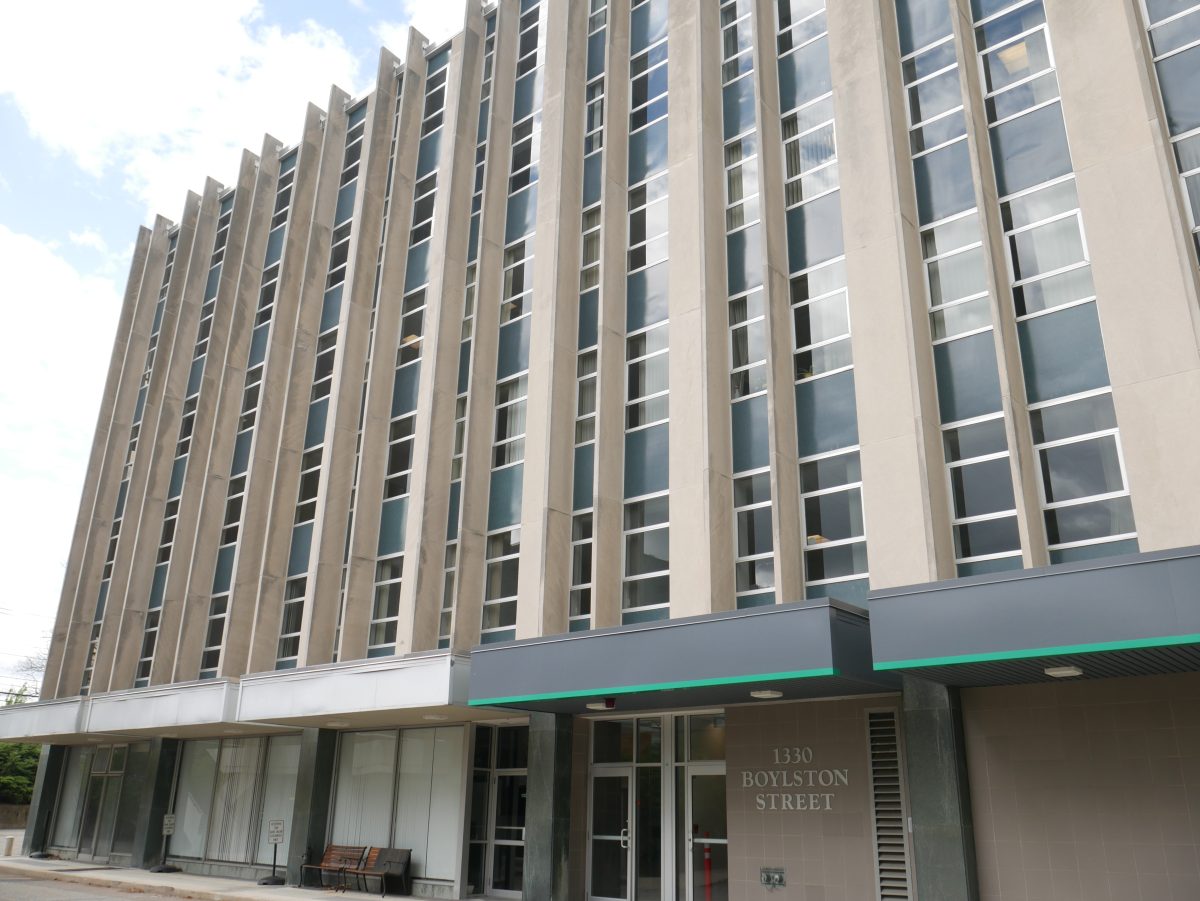
Brookline’s biggest opportunity for commercial development, an under-utilized stretch of Route 9 in Chestnut Hill, is hitting significant roadblocks.
After more than a year of committee meetings, a Town Meeting vote to rezone the area has been pushed back and is now at least another year away. The town’s planning staff are pivoting their approach after struggling to find consensus about the future of the site. And the developer who owns the most valuable piece of land on the corridor says he is now “exploring other options.”
City Realty, which purchased the partially-vacant office park at 1280-1330 Boylston Street for $41 million last year, has repeatedly scaled back its ambitious initial redevelopment proposal in response to neighborhood opposition.
“The status of this process is a little uncertain at the moment,” Clifford Kensington of City Realty wrote in an emailed statement to Brookline.News. “When the town began this study, we committed fully to participate in a process with a clear schedule and goal, to develop a set of recommendations and zoning to take advantage of the economic development opportunity in this corridor.”
But that process has become more complicated than initially anticipated, according to Kensington, as the town’s Planning Department moves away from working directly with City Realty’s proposal toward creating a broader “Planned Development Area” (PDA) framework for the entire corridor.
“We’d love to continue working with the community to refine our proposal and develop a vision for the property that everyone can get excited about. However, without a clear timeline or idea of next steps, we also will be exploring other options as we contemplate what is next for the site,” Kensington wrote.
The delays come as Brookline faces significant fiscal challenges and talk of another tax override in the next year. The main solution, most town leaders say, is more commercial development.
Timeline delayed, approach shifted
After initially aiming for a Town Meeting vote to change the zoning of the site at this month’s session, town leaders have adjusted their timeline to do so in May 2026.
“We’re more concerned about getting this done in the right way than we are about getting it done right away,” said Zach Tesler, a town planner involved in the process.
Meredith Mooney, Brookline’s economic development director, said that the shift to the broader Planned Development Area came after analyzing several iterations of City Realty’s proposal.
“One of the key challenges we are really trying to tackle is how we give appropriate consideration to the uniquely large sites, particularly ones with significant economic development potential,” Mooney said.
Among other things, the new approach could establish a requirement for a minimum amount of commercial square footage for any redevelopment proposal, which cities like Cambridge and Somerville have done for developments in Kendall Square and Assembly Row. City Realty’s most recent proposals have included both commercial property and some housing.
“There’s a very valid question: if we end up with just 25% developed commercial, is that an appropriate use of this opportunity for the town?” Mooney said.
Complicated by neighborhood push back

Part of what has slowed and complicated the redevelopment process is push back from neighbors and abutters to the developer’s proposals, town officials say. At meetings of a community advisory group set up to work on the rezoning, some residents and Town Meeting members have challenged City Realty’s plans repeatedly.
Among other things, they have opposed the density and height of preliminary proposals, and argued that the proposed development could create traffic problems on quiet streets behind the site.
City Realty “asked for more than they really needed” at first, said former Select Board member Michael Sandman, who has been leading meetings of the advisory group.
“One of the things that they did was suggest a 20-story building … which absolutely blew people’s minds,” Sandman said. That iteration would have included the tallest building in Brookline.
“So it took a while to … say to the neighbors, it’s not going to happen that way. Let’s figure out what we really need here. And that did unquestionably take some time.”
Ken Goldstein, an attorney hired by neighbors of the proposed project, said the shift in process is a positive development.
“We’re looking at a process now where we’re asking the question “What does the town want and need?” versus “What does the developer want to build?” he said. “It’s not in the town’s interest to see the character of that single-family style neighborhood be impeded by a development that’s not taking the sensitive issues into account.”
Goldstein said that the neighborhood behind the site and set back from Route 9, which he characterized as low single-family homes surrounded by open space and “bucolic” conditions, is not opposed to development, and recognizes that more density and height are feasible at the site. He said they are largely on board with building a hotel on the site – a major target of the town because of the tax revenue it would help bring.
“It’s not anyone’s intention right now to turn this into a political battle,” Goldstein said. “I think we can come up with a plan that is workable for the developer, or a developer, and acceptable to the community, both the immediate neighbors and the community at large.”
The commercial imperative
Town officials have described the area as Brookline’s “last frontier” for significant commercial development, with the potential to ease the tax burden on residents and help address the town’s cyclical financial problems. Currently, just 16% of the town’s property tax levy comes from commercial and industrial taxpayers, with residents shouldering the remaining 84%.
Hotel rooms and restaurant meals are subject to an additional local excise tax which goes directly to Brookline’s coffers.
“At a basic level, the more commercial development we have, the more likely it is that we are able to ask our commercial sector to shoulder a greater portion of the tax burden, which then takes it away from the residential side,” Town Administrator Charles Carey told Brookline.News last year.
On the town election campaign trail this spring, every candidate for Select Board talked about the need for more commercial development to help balance the town’s finances – and each specifically mentioned the Route 9 project.
Under an analysis of various scenarios for the site by a town consultant, the combination of a hotel, retail and office space and some new housing there could bring in between $2.5 and $5 million in net new revenue per year – that’s even after taking into account the added cost burdens on municipal services and public schools.
But Goldstein, who himself is a former Select Board and Planning Board member in Brookline, challenged the thinking that the site is a golden ticket for town finances.
“You can’t recoup the revenue issues in the town by over-developing one particular spot. It’s got to be part of an overall approach to an increased tax base,” he said.
The path forward

As the process stretches into another year of planning, the town is working on several fronts, including finalizing a transportation study for the area and researching other communities’ approaches to planned development areas.
Sandman, who said he will remain engaged with the project despite stepping down from the Select Board this month, expressed optimism that the town will get something done.
“I think there’s a pretty good chance for success for a substantial development. Not a development of the size and scale that City Realty proposed in the first place, but development that will provide significant net taxes to the town,” he said.