

The Brookline School Committee has rejected a controversial plan by district administrators to transition to a fully unleveled ninth grade English course next year.
Thursday’s decision, by a 7-2 vote, followed three weeks of vocal criticism of the plan by some parents, who argued a fully unleveled course would diminish academic rigor. After district administrators announced in early February that they would move forward with the fully unleveled course next year, the School Committee stepped in, asserting the change required their approval.
Thursday’s vote means the unleveled English course will remain optional next year, as it is this year, and college prep and honors level classes will be offered while school officials continue to study the impact of the pilot.
The pilot unleveled course, which 112 students opted to take this year, is part of a broader redesign of the ninth grade, motivated in part by a desire to address the overrepresentation in lower-level courses of students who are Black or Hispanic, or who have special education needs.
“We want our classrooms to reflect our demographic diversity,” said Anthony Meyer, the high school’s Head of School. “They do not.”
For administrators at the high school, the decision appeared to prompt uncertainty about whether the School Committee backed their efforts to address district-wide disparities.
“To me, it feels like killing equity work,” Meyer told the committee following the vote. “I know that’s not what you’re trying to do. But I am worried about the message I am carrying back to my faculty and staff about really important work that we need to do.”
School Committee Chair David Pearlman responded that the committee’s vote should not be interpreted as a rebuke of the unleveling plan.
“It’s just perhaps we want to be a little more cautious on our end and make sure we’re looking at all of the data comprehensively,” Pearlman said.
The vote followed more than two hours of discussion during which high school administrators and the teachers of the pilot course attempted to show that the pilot had been successful in its first semester.
About half the students enrolled in this year’s pilot would otherwise have enrolled in honors English and the other half would have enrolled in the college prep track, administrators said Thursday. Teachers in the pilot program have recommended honors English courses next year for 75% of students at an approximately equal rate across racial groups, according to data presented. In traditional college prep classes, fewer than one quarter of students were recommended for sophomore honors classes, and racial disparities were more pronounced in both the college prep and honors recommendations.
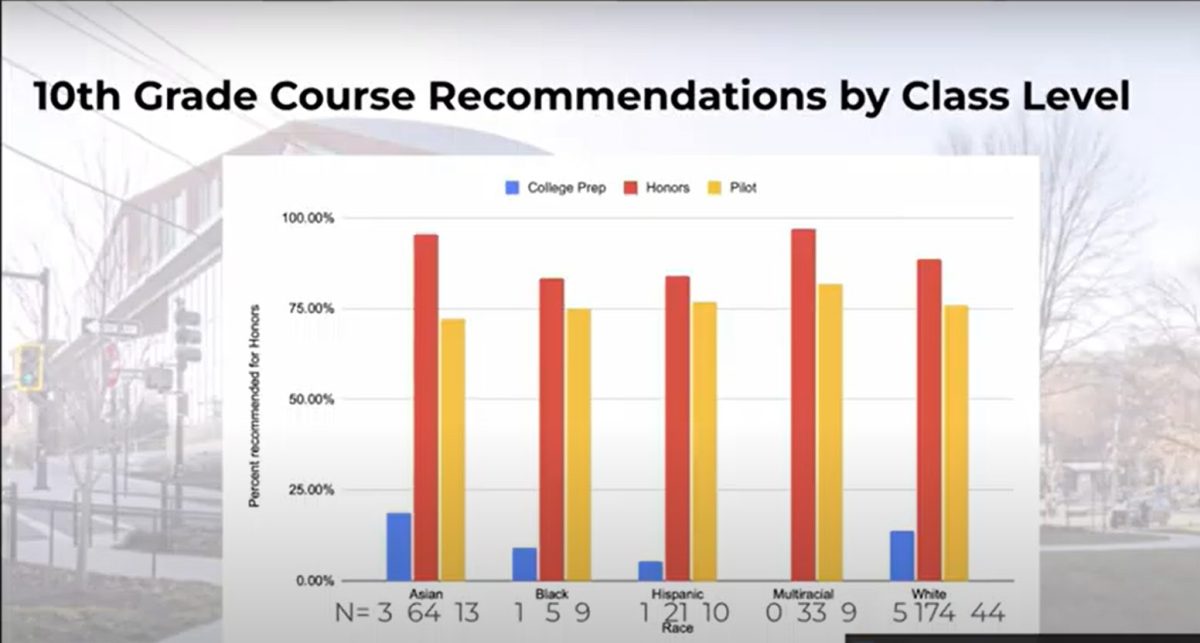
Responding to concerns that the unleveled course would fail to challenge high-performing students, district administrators said the course allowed students to select books at various points of the year that were more challenging than those offered in the honors course.
In a survey of all ninth grade English students, those in the pilot rated their course work as challenging at a slightly higher rate than the students in honors courses did, administrators said.
Other data presented were inconclusive. Across nearly all racial groups, for example, students in the pilot performed better than students in the college prep course and worse than those in the honors course on a standard midyear exam and in first-semester grades.
“If we’re trying something new, we need to know that what we’re trying makes sense and works. And I’m not convinced, I guess, just yet,” said Helen Charlupski, one of the School Committee members who opposed implementing the fully unleveled course.
Natalia Linos and Suzanne Federspiel were the only two School Committee members to back the course’s implementation.
“I think it’s important to highlight that our choice to stay in this system also requires data,” Linos said. “And the data that I’ve seen is this system is failing many of our kids.”
The committee’s vote followed impassioned arguments from parents and students both in favor and against expanding the pilot course. Earlier last week, Brookline.News published a letter to the editor urging further study signed by more than 100 high school parents and other stakeholders. “Why is this experiment being expanded before we have solid answers about its affects on all students?” they wrote.
Joshua Paradise, the parent of an eighth grader, opposed moving forward with the de-levelling plan.
“The unfortunate irony of the plan to eliminate leveled classes is it will do the most harm to our least-advantaged students,” Paradise said. “Parents with means and privilege provide outside resources when Brookline schools do not.”
Laura Cleves, a high school senior and non-voting student representative on the School Committee, pushed back against the notion that the unleveled course is less rigorous.
“In ninth grade, I didn’t feel challenged enough, even though I was in an honors level class,” Cleves said. “Quite frankly, having the opportunity to read a novel like The House of the Spirits, or something like Crime and Punishment [both of which are offered in the unleveled course], I would have eaten that up.”
Following the vote, Chora Bayer, a ninth grader in the pilot course, expressed disappointment in the School Committee’s decision.
“The pilot class is just something I really feel strongly about,” Bayer said. “It’s just more creative and people don’t like that.”