
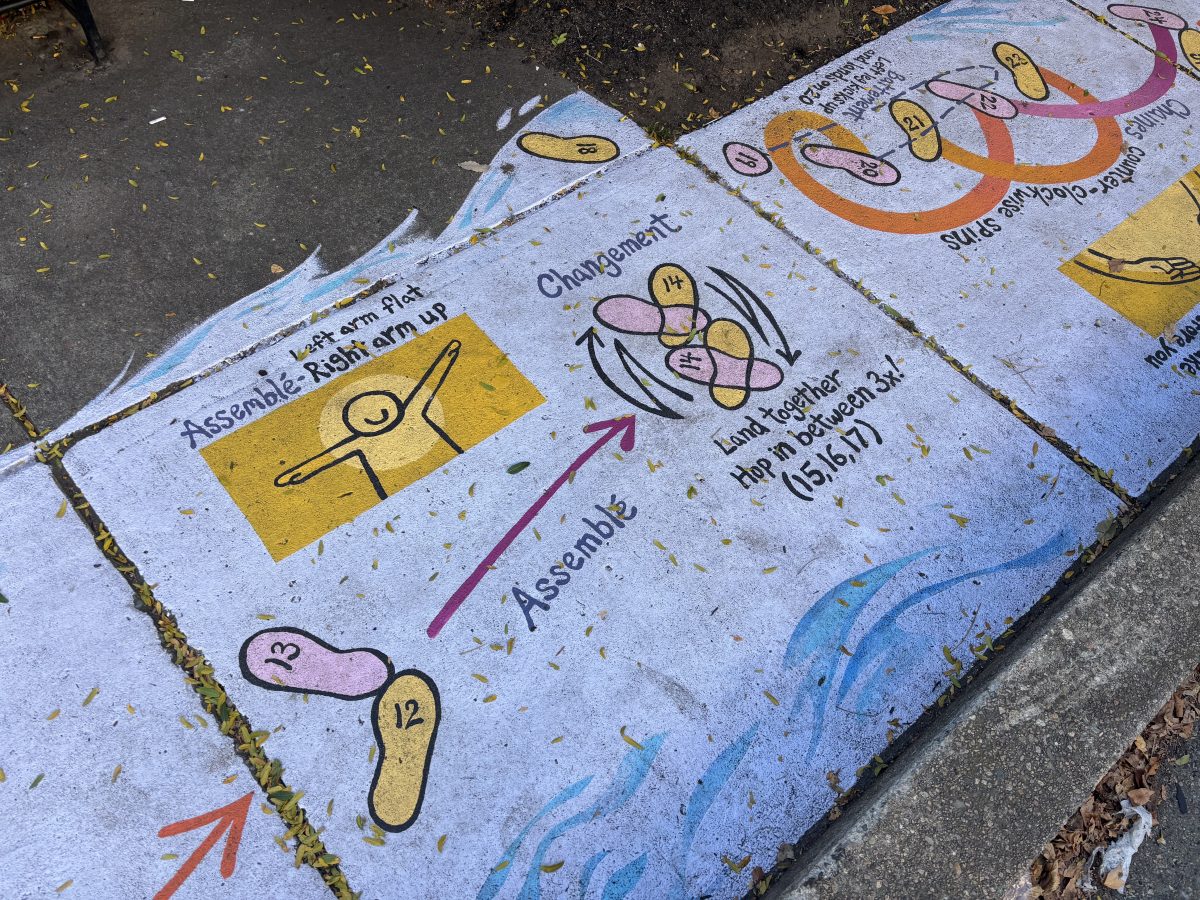
Caitlyn Kwan stood on the balls of her feet, as instructed by the footstep silhouettes painted on the ground beneath her and the directions that told her to “travel on your toes.”
With her arms held out in front of her in a semicircle, she lightly walked four steps — right, left, right, left — before kicking her right leg up, a ballet move called a battement, and cycling through a series of spins, jumps and footwork.
The choreography that Kwan helped design is displayed on the sidewalk as an interactive mural, tucked away in an alley just off Harvard Street in Coolidge Corner. The dance diagram is one of two painted by artist and illustrator Kit Collins and unveiled last month as part of “Let’s Dance, Brookline!” an arts initiative by Brookline Art Makes Community.
In 2022, Brookline set aside $225,000 in federal Covid relief funding for BAMC, a public art and placemaking initiative developed to support local businesses recovering from the pandemic by driving foot traffic, according to Aaron Norris, senior economic development planner for the town.
So far, BAMC has invested in several art projects that residents may have noticed, like painted utility boxes and turkey sculptures.
After responding to BAMC’s 2023 call for artists, Collins, 30, was selected for the town’s “Art Around Town” initiative. She had previously worked on interactive dance-related murals in Cambridge and Roslindale Village, and she wanted to bring something similar to Brookline as a nod to its dance scene.
It was important to her that community members are able to participate actively in the murals.
“Artwork shouldn’t be something that you just look at,” she said. In a museum or gallery, art is usually meant to be thought about and “absolutely not touched.” She wanted to turn that on its head, she said. “Not only are you supposed to have a role in this, but you’re literally supposed to step on it. This is about you. This artwork comes alive when you do it.”
Working with the BAMC team, Collins issued a call for choreographers and connected with Kwan, a research coordinator at Dana Farber Cancer Institute and Brigham and Women’s Hospital, and Sutikshna Veeravalli, a teacher at Brookline High School, both of whom are also dancers. Each choreographed a dance routine and collaborated with Collins who painted the visual representations of the routines.
Kwan, 25, hadn’t planned on applying for the opportunity, but her students, older adults at the Brookline Senior Center where she volunteers teaching dance, encouraged her to take the leap.
“I’ve always wanted to use dance with another form of art,” Kwan said. “I always thought it would be a more audio one like maybe slam poetry and dance. But I never thought a mural could be on the floor and could incorporate dance.”
Kwan’s dance, titled “A Mat that Seats Many,” features a mix of grand allegro — large movements across the floor — and petit allegro — smaller, more precise movements. The maneuvers have names like assemblé, changement and glissade, the last of these a move Kwan had been working on with her students.
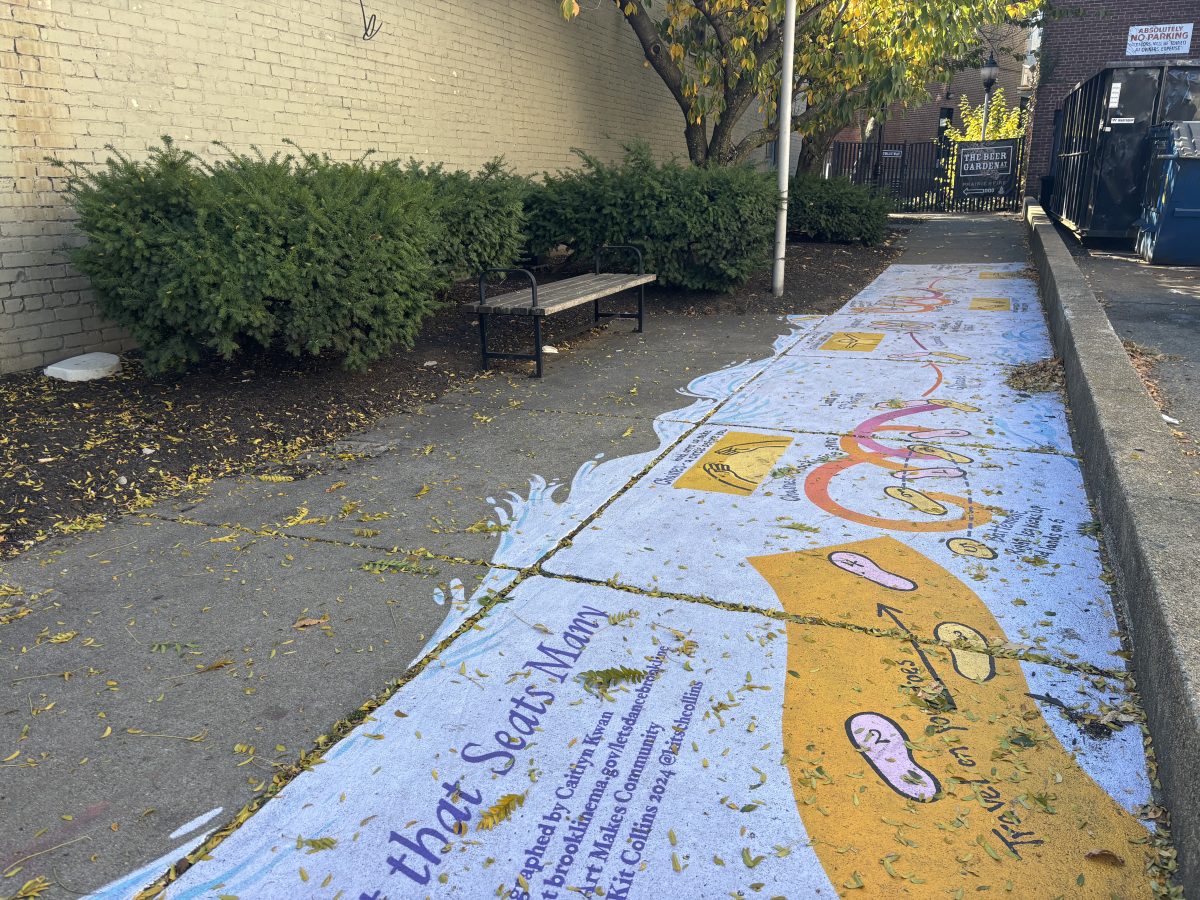
To the average person, these words may be unfamiliar or intimidating, so to help interested participants, the mural includes numbered silhouettes of footprints to denote the order in which each of the 28 steps should be performed along with accompanying instructions on how the arms should be held.
Equally difficult to render visually were the chaines, a series of three clockwise spins. Collins and Kwan landed on using three overlapping colorful arcs to denote the motion.
The choreography is a tribute to Kwan’s native Hawaii, her dance students and her life in Boston.
“Art in itself is healing,” she said, adding that it can encourage people to try new hobbies they otherwise wouldn’t have.
At the intersection of Harvard Street and Washington Street in Brookline Village is “Adavu: the Building Blocks of Movement,” the mural portraying Veeravalli’s Bharatanatyam routine, a traditional southern Indian dance.
Veeravalli’s mural is a harmony of warm tones: earthy reds, yellows and oranges, complemented by the fallen yellow and brown leaves of the season.
Bharatanatyam is characterized by rhythmic footsteps and is made of building blocks, each called adavu. There are about 40 of these building blocks, Veeravali said, which may seem limiting.
“What people might perceive as constraints, I think, is the platform for creativity in this dance form,” Veeravalli, 30, said. Just as English is made up of 26 letters that are combined in various ways to create a complex language, so can the building blocks of Bharatanatyam be combined to conceive a rich movement art.

illustrated in the mural “Adavu: the Building Blocks of Movement.” Photo by Mandile Mpofu
Veeravali’s parents immigrated to the U.S. from India, and while her traditional dance has always been an integral part of her identity, she never had the space to share this part of her in school. No one asked about it, so she didn’t share, she said. That her heritage is permanently stamped onto a sidewalk feels especially validating.
“It makes such a difference to walk by a place and even if I don’t engage in it, just to know that this is a space that’s open to movement and accessibility and just [a window] into things that aren’t familiar to you,” she said.
The murals will likely grace the sidewalks for five to 10 years, according to Norris, the town planner working on BAMC,
One of their goals is to boost local businesses, but he said that the emotions they elicit in passersby are equally important.
“Interacting with the artwork will bring some sense of joy,” he said.